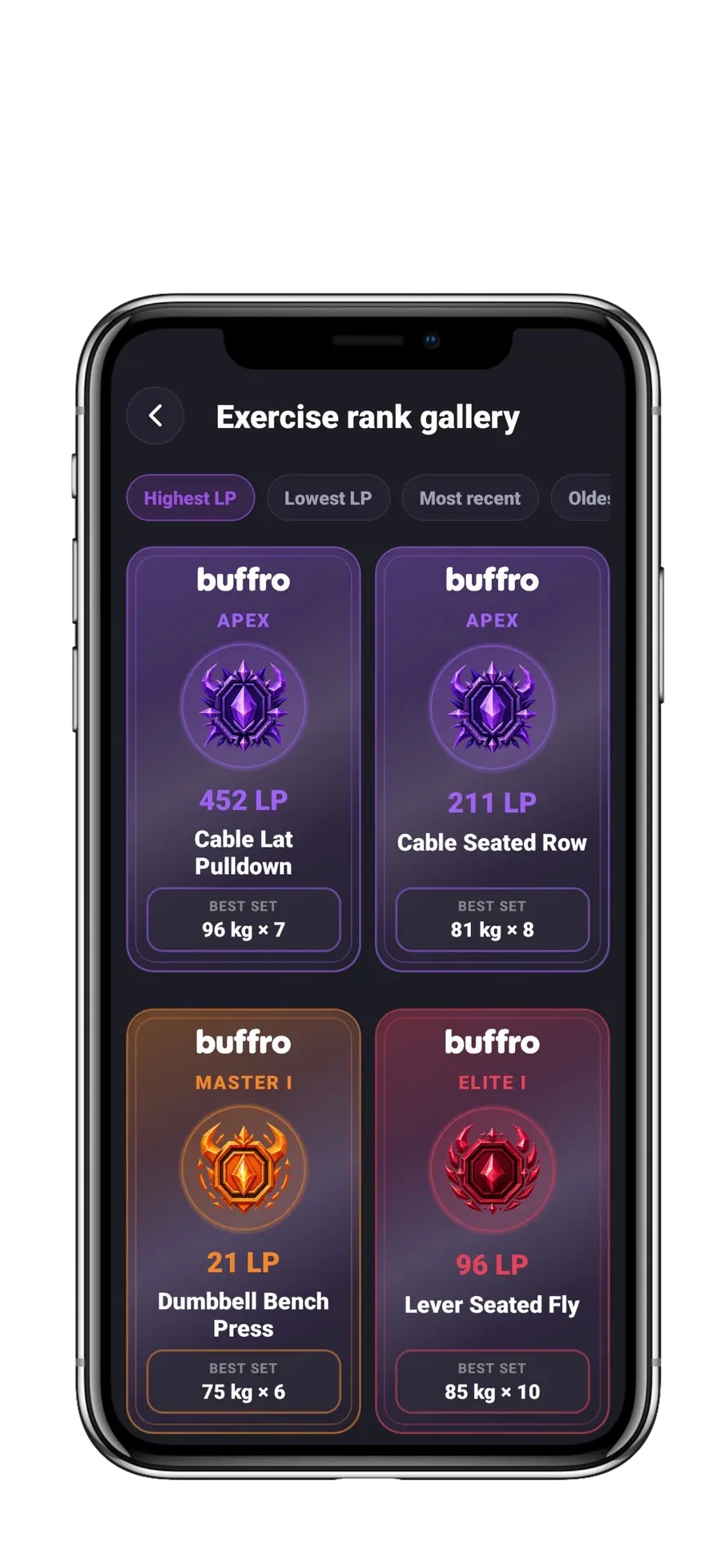
Buffro has published a public methodology explaining how its iOS and Android workout tracker evaluates strength across 1,102 exercise records. The resource documents nine progression tiers, four calculation branches, bodyweight and sex adjustments, and the exercise types the system deliberately excludes when a strength score would be misleading.
The methodology is available at https://buffro.app/research/strength-standards and is designed to make the app’s Strength Ranks feature easier to understand. Of the 1,102 exercise records in the underlying source, 997 movements are rankable. Buffro excludes 26 time-based movements, 65 trivial-repetition movements, and 14 unsupported movement types instead of assigning them scores from inputs that do not describe strength reliably.
Buffro uses four calculation branches because a single load-to-bodyweight ratio does not fit every exercise. External-weight movements such as squats, presses, rows, curls, and machine exercises use an estimated one-repetition maximum relative to bodyweight. Bodyweight-repetition movements such as pull-ups and push-ups use repetitions adjusted for bodyweight and movement difficulty. Weighted bodyweight movements account for supported bodyweight plus external load, while assisted bodyweight movements account for the assistance used.
Each supported exercise progresses through the same nine tiers: Beginner, Novice, Intermediate, Advanced, Expert, Veteran, Elite, Master, and Apex. Thresholds vary by exercise and sex. The public tables show the adult-under-40 baseline, while Buffro applies age coefficients beginning at age 40 inside the app. Bilateral dumbbell exercises use combined external load to match how Buffro records them.
The public resource also includes interactive examples for exercises such as the cable lat pulldown, pull-up, and barbell squat. Visitors can adjust bodyweight and sex to see how the displayed thresholds change. Buffro describes the standards as training benchmarks rather than medical limits or competition classifications.
Strength Ranks is one part of Buffro’s broader workout-tracking system. The app supports offline-first recording of exercises, sets, repetitions, weight, and notes. Optional online features include AI coaching, cloud sync, nutrition tools, and private Workout Buddies. Approved buddies can share ranks, streaks, and selected activity without exposing exact sets, weights, notes, measurements, nutrition, or photos.
The publication gives coaches and users a reference for understanding which inputs change a rank, how movement categories are handled, and why some exercises do not receive one.
Buffro is available free on the Apple App Store and Google Play. Core workout tracking is available without a subscription, while optional premium features include AI capabilities. Store pricing and trial availability can vary by platform and region.
The methodology and interactive strength tables are available at https://buffro.app/research/strength-standards. Buffro can be downloaded for iPhone at https://apps.apple.com/us/app/buffro/id6760926241 and for Android at https://play.google.com/store/apps/details?id=com.buffro.app.
Buffro is an offline-first workout tracker for iOS and Android from PT Duo Digital Internasional. It combines workout logging, strength ranks, a 1,000+ movement exercise library, optional AI coaching, nutrition tools, progress tracking, and private social features. More information is available at https://buffro.app.
duodwdigital@gmail.com
PT Duo Digital Internasional