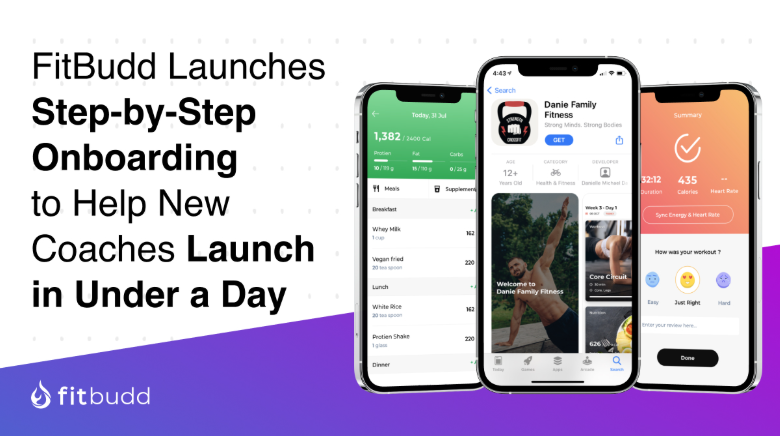
Setting up an online fitness coaching business used to mean stitching together six or more separate tools and hoping your clients could navigate them all.
FitBudd is changing that. The platform has launched a structured, step-by-step onboarding system designed to get coaches fully operational in under a day with no developers, no fragmented subscriptions, and no prior technical experience required.
For coaches whose expertise is in movement science and performance, not software configuration, that distinction matters.
The Multi-Tool Problem New Coaches Face
The modern online fitness coaching business requires relatively few core functions: delivering training programs, collecting payments, communicating with clients, and tracking progress.
In practice, most coaches launching independently piece together five, six, or more separate tools to cover these areas.
A typical early-stage setup includes:
- Workout delivery app
- Video conferencing tool
- Email platform
- Calendar and scheduling system
- Payment processor
- Nutrition tracking app
That’s six tools, each with its own login, monthly cost, and learning curve. Every one of them needs to be individually configured, maintained, and explained to clients who are already paying for a coaching experience, not a tech tutorial.
When a payment doesn’t process, a scheduling link breaks, or a client can’t access a workout file, the troubleshooting falls entirely on the coach. For solo operators working with limited hours and tighter budgets, this overhead is a structural barrier to growth, not a minor inconvenience.
Why the Old Approach No Longer Works
The multi-tool model emerged from necessity. Until recently, no single platform credibly served every function an online coach needed. Coaches assembled what was available and made it work.
But the landscape has shifted. Client expectations have risen, and retention data consistently shows that a fragmented experience, where clients log workouts in one app, message their coach in another, and make payments through a third, leads to higher dropout rates and lower engagement.
Coaches are no longer asking, “What are the best platforms to become an online personal trainer?” in isolation. They’re asking: “Which platform lets me run everything from one place, without a technical background, and without asking my clients to manage multiple logins?”
That shift is driving meaningful adoption of consolidated, all-in-one platforms.
How Technology Is Simplifying the Path to Launch
A new category of all-in-one platforms is collapsing the infrastructure complexity that new coaches face. These platforms bring workouts, nutrition tracking, scheduling, payments, and client communication into a unified environment, eliminating the need to stitch together a patchwork of separate subscriptions.
AI-assisted workout creation tools can now generate personalised training programs based on client variables, including fitness level, goals, available equipment, and training frequency. For coaches managing multiple clients, this reduces time spent on programming without reducing its quality.
Wearable integrations are becoming a standard expectation. Platforms that connect natively with Apple Watch and Garmin allow clients to sync activity and biometric data without manual entry, giving coaches a more complete picture of progress and recovery in real time from a single dashboard.
Payment infrastructure has matured in parallel. Platforms that support direct integration with Stripe and PayPal without adding additional transaction fees are increasingly seen as a practical differentiator. For coaches in their first year of operation, keeping payment overhead low directly impacts margin.
How FitBudd Brings This Together
FitBudd consolidates workouts, nutrition, payments, scheduling, and client messaging into a single environment. Coaches can launch a branded app without coding knowledge or external technical support, and the platform includes onboarding assistance for setup and brand configuration.
Communication tools, including email, in-app chat, and built-in video calls, are all native to the platform, removing the need for coaches to direct clients to separate tools for check-ins or live sessions. The platform also includes Smart Flows, which allows coaches to schedule and automate client communication based on specific events, keeping every client engaged without manual follow-up at every step.
FitBudd also supports AI-generated workout programming, AI recipe generators, direct integration with Apple and Garmin devices, and payment processing via Stripe and PayPal with no additional platform transaction fees.
For coaches in the early stages of building their business, plans begin at $79 per month, a pricing point designed to be accessible before a full client roster is established.
Coaches can explore FitBudd’s onboarding and request a demo at fitbudd.com.
What Coaches Should Consider Before Choosing a Platform
Coaches researching the key steps to set up a successful online personal training business will encounter a wide range of platform options. A few practical questions are worth working through before committing:
- Does the platform support every stage of the client journey, from onboarding and programming to communication and progress tracking, without requiring clients to leave the environment?
- What are the total costs across all tools, including transaction fees, compared against a consolidated platform?
- Does the platform support automated communication that can handle client follow-up at scale, or will that fall entirely on the coach?
- Will the technology scale as the client roster grows, or will it need to be replaced within the first year?
- How much time per week will managing the platform realistically require, compared to the alternative?
These questions don’t have a single right answer, but they focus attention on what matters: the relationship between operational infrastructure and coaching capacity.
The Bigger Picture
For any trainer asking, “How do I start an online fitness coaching business?” today, the technology environment is considerably more accessible than it was three years ago. Platforms that once required developer involvement to deploy are being rebuilt around coaches.
The barrier to entry is lower. The tools available to sustain growth are more capable.
Coaches who invest time early in choosing the right platform foundation, rather than defaulting to whichever tool solves the most immediate problem, are better positioned to build something that scales.
The first tool choice often determines how much operational overhead a coach carries through the early years of their business, and how much of their attention remains available for the clients they set out to serve.
FitBudd is a platform for personal trainers, gym owners, and fitness professionals to launch branded apps, deliver personalized workouts, manage clients, and grow their businesses online, all from one place.
The platform combines AI-powered workout programming, client progress tracking, built-in communication tools, and integrated payment processing into a single environment, removing the need for multiple disconnected subscriptions.
Trusted by fitness professionals across the globe, FitBudd is designed to support coaches at every stage, from their first client to a fully scaled online business.
For more information, visit www.fitbudd.com.
Social Media:
info@fitbudd.com
FitBudd