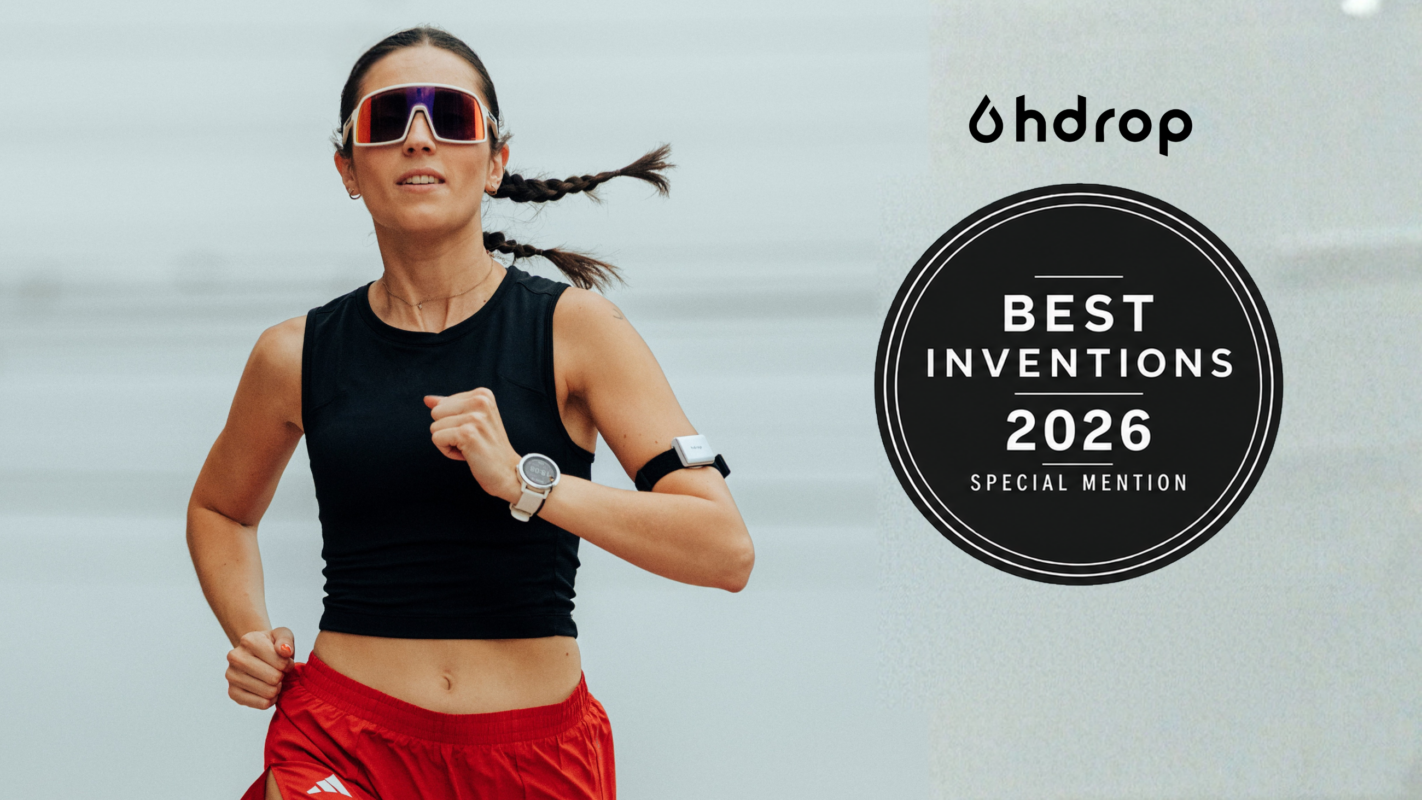
hDrop Technologies Inc. today announced that hDrop Gen 2, its reusable sweat-sensing wearable, has been selected for a Special Mention in TIME’s Best Inventions of 2026. The recognition marks a significant milestone for the company as it takes its next step toward making sweat sensing more accessible: bringing its technology beyond its own wearable and into products developed by other manufacturers. Through its new hDrop Industry Collaboration Program, the company is opening opportunities for wearable manufacturers to integrate real-time sweat and electrolyte sensing into their devices.
“We’re incredibly proud to receive this recognition from TIME,” said Adria Abella, co-founder of hDrop. “It reflects years of work from our team and the support of the athletes and partners who have helped us get here. Our vision has always been to make personalized sweat data accessible to more athletes, and now we have an opportunity to take that mission even further by bringing our technology into the wearables they already use.”
Why sweat sensing matters: The technology behind hDrop
Sweat is one of the body’s primary mechanisms for regulating temperature during exercise, but fluid and sodium losses vary significantly between athletes and conditions. Measuring these losses provides valuable information to personalize hydration strategies, support endurance performance, and reduce the risks associated with inadequate fluid and electrolyte replacement.
hDrop has developed a fully reusable wearable that tracks sweat rate, sodium concentration, and fluid and electrolyte losses in real time, helping athletes better understand their individual hydration needs during exercise. Unlike traditional sweat-testing methods that rely on single-session measurements, hDrop provides continuous insights into how sweat losses change throughout training.
The technology has undergone independent scientific evaluation, demonstrating approximately 92% accuracy in sweat-loss tracking and 87% accuracy in sweat sodium-loss estimation during controlled running and cycling trials. The findings, published in Physiology in 2026, provide an independent scientific foundation for hDrop’s continued development of wearable sweat-sensing technology.
Bringing TIME-recognized sweat-sensing technology to the next generation of wearables
Building on the technology recognized by TIME, hDrop is introducing its Industry Collaboration Program, inviting wearable manufacturers to explore the integration of sweat and electrolyte sensing into their own products.
At the center of the program is the hDrop Sweat Integrated Circuit (hDrop Sweat IC), a chip currently in development that is designed to bring hDrop’s proprietary sweat-sensing technology and signal processing into third-party devices. Working with compatible skin-contact electrodes and product-specific calibration, the Sweat IC is designed to provide real-time data on sweat rate, sodium concentration, and cumulative fluid and sodium losses directly to a manufacturer’s hardware and software.
One of the most promising applications is the use of ECG electrodes for both heart-rate monitoring and sweat sensing. This approach enables manufacturers of chest straps, armbands and other skin-contact wearables to introduce sweat-sensing capabilities using electrode configurations already present in their products, subject to technical evaluation and calibration.
For manufacturers, this opens opportunities to develop new hydration-related features and training insights within their existing product ecosystems, without having to build the underlying sweat-sensing technology from scratch.
“The hDrop Sweat IC represents the next step in making sweat sensing a standard capability in wearable technology,” said Amine Mansouri, electronics engineering lead at hDrop. “By combining our sensing technology and calibration expertise with manufacturers’ existing hardware and software platforms, we aim to make integration more accessible and bring personalized sweat data to a much wider range of devices.”
Through the program, hDrop is working with interested manufacturers to evaluate electrode compatibility, define integration and calibration requirements, and explore potential applications. Companies interested in integrating sweat sensing into their products can contact hDrop to discuss technical feasibility and development kit opportunities.
To discuss an evaluation or request a development kit, visit hdroptech.com/oem-sensor-integration/ or contact info@hdroptech.com.
The program complements hDrop’s standalone wearable business, which the company continues to develop and support.
hDrop Technologies Inc. develops an accurate easy to use reusable sweat-sensing technology for sports and performance applications. Its work spans standalone wearables, proprietary signal processing and manufacturer integration, with a focus on helping athletes understand sweat and electrolyte losses during exercise.
info@hdroptech.com
hDrop Technologies Inc.