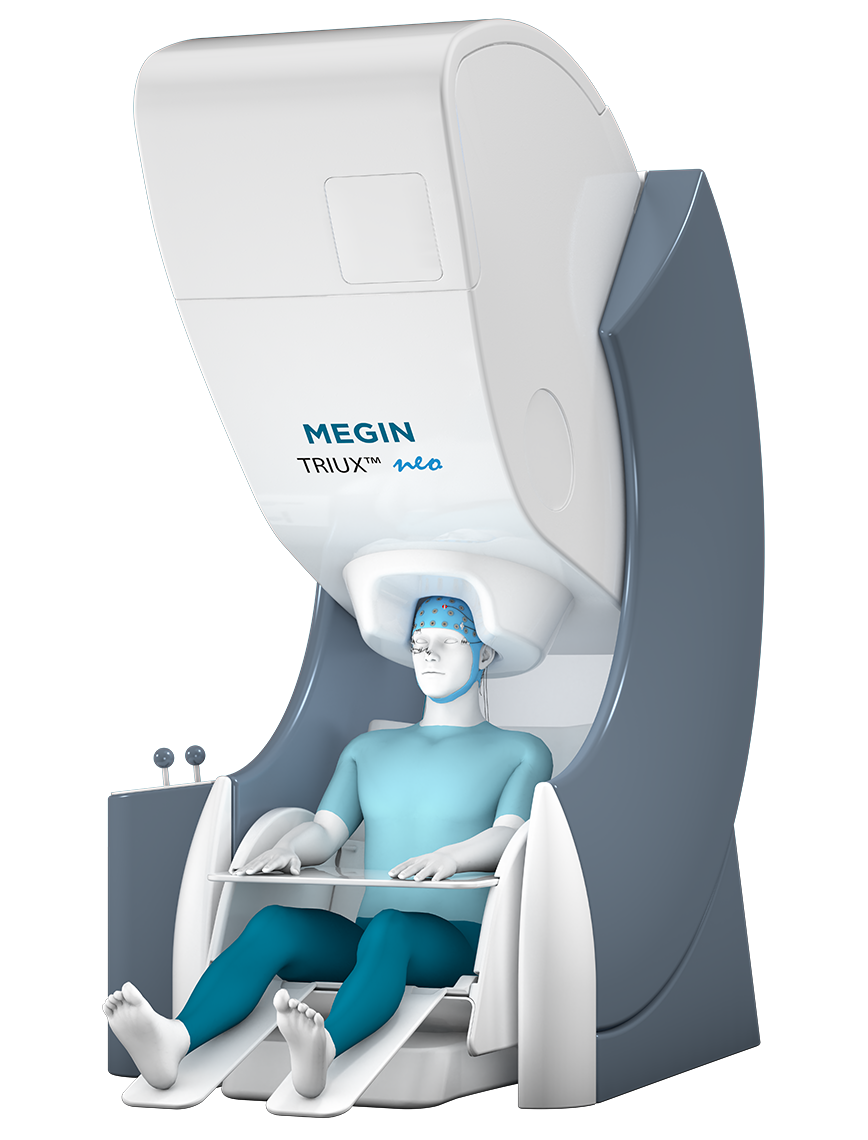
MEGIN, the global leader in magnetoencephalography (MEG), has launched a side-by-side dual-MEG hyperscanning facility at Tsinghua University in Beijing, in collaboration with Aalto University’s Department of Neuroscience and Biomedical Engineering. The installation brings together two MEGIN TRIUX™ neo systems in adjacent magnetically shielded rooms, linked through a custom integration layer developed by the Aalto University team, enabling simultaneous whole-head MEG recording from two interacting participants at a single site, with millisecond-level synchronization of the two MEG data streams, video and audio.
Initial scientific work from the facility will be presented at BIOMAG 2026, the biennial international conference of the biomagnetism community, held in Beijing on 23-25 August.
Hyperscanning, the simultaneous recording of brain activity from two or more people as they interact, is emerging as a powerful tool for understanding the brain basis of social behavior and collaboration. It moves researchers beyond studying the single brain in isolation, allowing them to examine how two brains engage during conversation, cooperation, and play. While hyperscanning has typically been conducted using electroencephalography (EEG) or functional magnetic resonance imaging (fMRI), both involve trade-offs relative to MEG: EEG captures rapid activity but localizes brain sources less reliably, while fMRI offers spatial detail but cannot resolve the moment-to-moment dynamics of social exchange. MEG combines millisecond temporal resolution with multi-source localization, allowing researchers to study how brain activity changes as people predict and respond to one another.
Until now, MEG-based hyperscanning has typically required two laboratories in different locations linked by long-distance connections, introducing latency and constraining the kinds of interaction that can be studied. The Tsinghua University facility removes that constraint: both participants are co-located, see and hear each other through a direct audio–visual link between the two magnetically shielded rooms (MSRs), and their brain data are synchronized at the millisecond scale for joint analysis.
Each MSR houses a TRIUX neo, MEGIN’s flagship MEG system, which captures neural activity non-invasively. Because the facility comprises two full whole-head systems, hyperscanning can be carried out between two adults at full sensor coverage, while full pediatric capability is preserved in both rooms. The Aalto University Neuroimaging team selected and integrated the supporting hardware alongside the MEGIN installation and the open source hyperscanning and synchronization software developed by Dr. Andrey Zhdanov. Together, these elements enable unified, real-time experimental control across both systems.
A new instrument for social neuroscience
“MEG hyperscanning research has been ongoing at Aalto University for more than a decade, but until now the setup typically required two subjects in two different laboratories, linked over long distances,” said Lauri Parkkonen, PhD, Professor at the Department of Neuroscience and Biomedical Engineering at Aalto University and Senior Technology Advisor to MEGIN. “Tsinghua University is different – two TRIUX neo systems in adjacent MSRs, hardwired together, with synchronized audio and video so that participants can genuinely interact in real time, like a Zoom call but without the internet in between. That difference matters. Social interaction is unique and proactive every time it happens, and to understand its brain basis you need both participants recorded together, at millisecond resolution, with the kind of spatial precision MEG provides. This installation gives the field a research instrument it has not had before.”
“Building a MEG hyperscanning facility is a methodological problem before it is a neuroscience problem,” said Veikko Jousmäki, PhD, Head of Aalto Neuroimaging Infrastructure, Senior Scientist, and Consultant for MEGIN at Aalto University. “Two whole-head systems have to behave, for the duration of an experiment, as a single instrument, clock-synchronized at the microsecond level, with audio and video latencies tight enough that two people can genuinely interact rather than wait for each other. The combination of dedicated hardware, open source hyperscanning and synchronization software is what makes the Tsinghua University installation unique, building on more than a decade of methods work at Aalto. It is an excellent example of what a deep methods collaboration with MEGIN, Aalto University and the team at Tsinghua University can produce.”
“Hyperscanning is another way researchers are deriving greater value from the data MEG captures,” said Gordon Baltzer, President of MEGIN. “With two TRIUX neo systems configured to record two participants simultaneously, Tsinghua University and Aalto University are expanding what is achievable with MEG-based brain imaging. This reflects MEGIN’s core focus: developing system capabilities that help researchers and clinicians extract more meaningful information and greater utility from MEG data.”
A three-way collaboration
The Tsinghua University facility is the product of a close partnership between three institutes. MEGIN delivered and installed the two TRIUX neo systems. Building on more than a decade of MEG hyperscanning research, including foundational work published in Neuron (Hari et al., 2015), Aalto University contributed the methods expertise behind the facility’s cross-system integration. Tsinghua University provides the site, scientific leadership, and research program the facility will support.
To learn more about MEGIN, please visit www.megin.com.
MEGIN is a global neuroscience technology company and the world leader in magnetoencephalography (MEG), a non-invasive functional brain imaging technology that captures neural activity with millimeter spatial accuracy and millisecond temporal resolution. Headquartered in Espoo, Finland, MEGIN has over 30 years of experience developing, manufacturing, and supporting MEG solutions for hospitals and research institutions worldwide. Its flagship system, the TRIUX™ neo, provides clinicians and researchers with a uniquely precise, real-time view of brain function, supporting clinical indications for epilepsy and presurgical planning and scientific applications across neurology, neurosurgery, and neuroscience research, including brain tumors, traumatic brain injury and concussion, stroke, and neurodegenerative disease. Through the MEG Maps™ platform, MEGIN is actively driving the field toward an open, AI-enabled future for brain imaging.
Media Contact: info@megin.com | www.megin.com
Copyright 2026 © MEGIN – TRIUX™ neo is available for sale in the United States, European Union, UK, Japan, Canada, as well as certain other countries. In other geographical areas, contact your local MEGIN representative.
MEGIN’s new platform MEG Maps™ powered by TRIUX™ neo and MEGreview™ is available for sale in the United States, Canada and Japan and is currently under EU MDR review in preparation for commercial distribution and sale in the EU area. Availability in other markets is subject to local regulatory approvals.
TRIUX™ neo is intended to non-invasively record brain activity, and when interpreted by trained physicians, to help localize these active areas. Caution: Federal law (USA) restricts this device to sale by or on the order of a physician.
jeff@threehorizonsgroup.com
Three Horizons Group