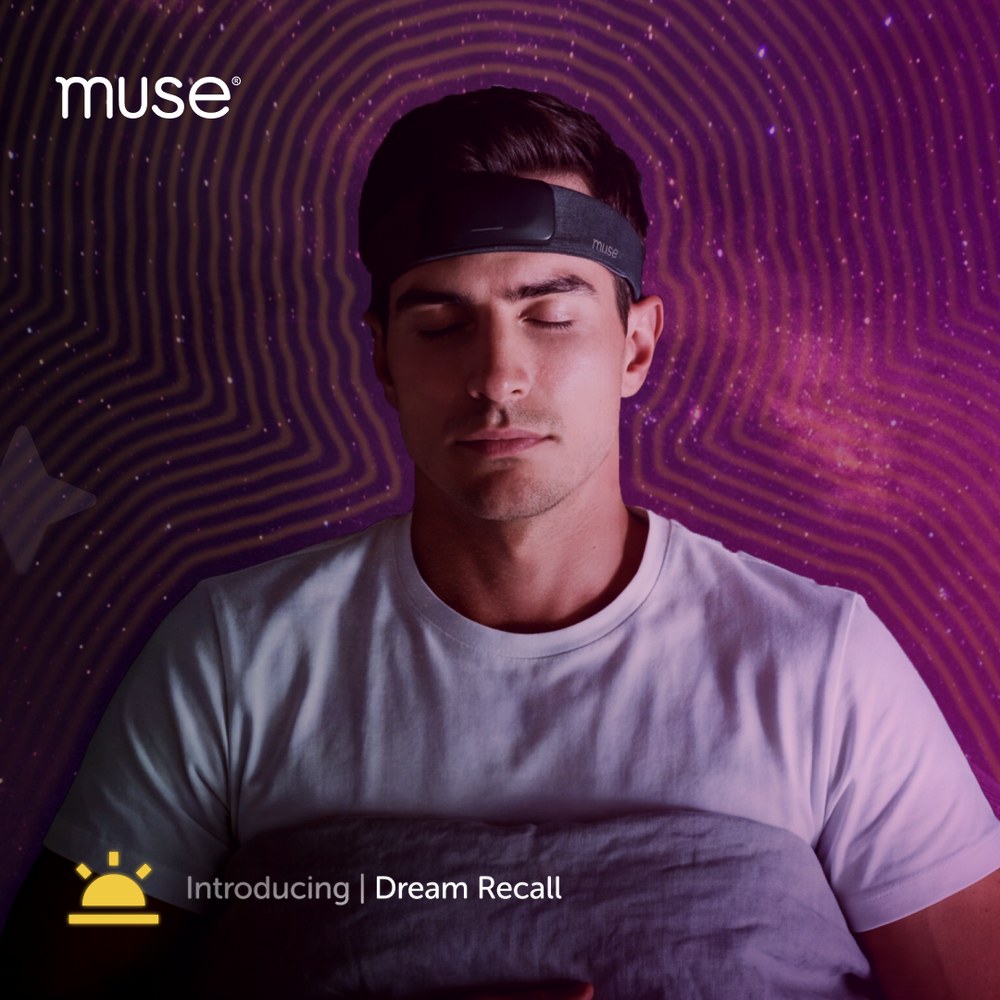
Tonight you will dream four to six times. By breakfast, almost all of it will be gone. Across a lifetime, dreaming adds up to roughly six years of experience you never keep. Muse by Interaxon today opened the beta for Dream Recall, a feature that times your wake-up to a dream so you can remember it, revisit it, and work with it. Dream Recall is part of Smart Wakeup and is available now in beta to current Muse Premium subscribers with a Muse S or Athena.
What you lose every morning
The research on what dreams actually do keeps building the same case: they are worth keeping.
Dream about a task, and you do it better. In a Harvard Medical School nap study, people who dreamed about a maze they had just learned improved roughly ten times more on a retest than other nappers who slept the same amount and did not dream about it. The finding was replicated in a full overnight study in 2019.
The edge of sleep is a creative sweet spot. Paris researchers gave people number puzzles with a hidden shortcut, then let them doze. Those who drifted for as little as one minute into the lightest stage of sleep were nearly three times more likely to find the shortcut than those who stayed awake, 83 percent versus 31 percent. Sink deeper, and the effect vanished. Thomas Edison napped holding steel balls to catch exactly that moment. He was right.
The sleeping brain replays what matters, even when memory fails. In a study published in Science, people who spent hours playing Tetris saw the falling blocks again as they drifted off. So did patients with severe amnesia, who could not remember playing the game at all.
Dreams can hold a conversation. In 2021, four independent labs in France, Germany, the Netherlands, and the United States held real-time, two-way exchanges with lucid dreamers during REM sleep, using sounds trained while awake and recognized inside the dream.
History agrees with the labs. Otto Loewi said the experiment that won him a Nobel Prize arrived in a dream, and Paul McCartney has said the melody for Yesterday did too. Those survived for one reason: someone woke up close enough to the dream to write it down.
Dreaming is also emotional work. Suppress REM for a single night, and negative mood measures higher the next morning.
Why your dreams disappear
Forgetting a dream is not a personal failing; it is how the sleeping brain is built. Everyone dreams, including people who swear they never do. When French researchers filmed sleep-disorder patients who claimed they had never dreamed in their lives, those patients argued, gestured, and acted out dreams from inside REM.The dreams were happening. Their memories didn’t survive the night.
During REM, the brain chemistry that files experience into long-term memory runs quiet, so dreams are never written down the way waking events are. What is left is a fragile trace, and waking overwrites it within minutes: movement, light, and the first thoughts of the day scatter the dream. That is why you tend to keep only the dream you woke up inside. In a 2021 CBS News poll, only about one in ten adults said they always remember their dreams, and more than a third of adults over 30 said they rarely or never do. Recall is a timing problem, not a talent. Muse was built for timing problems.
How Dream Recall works
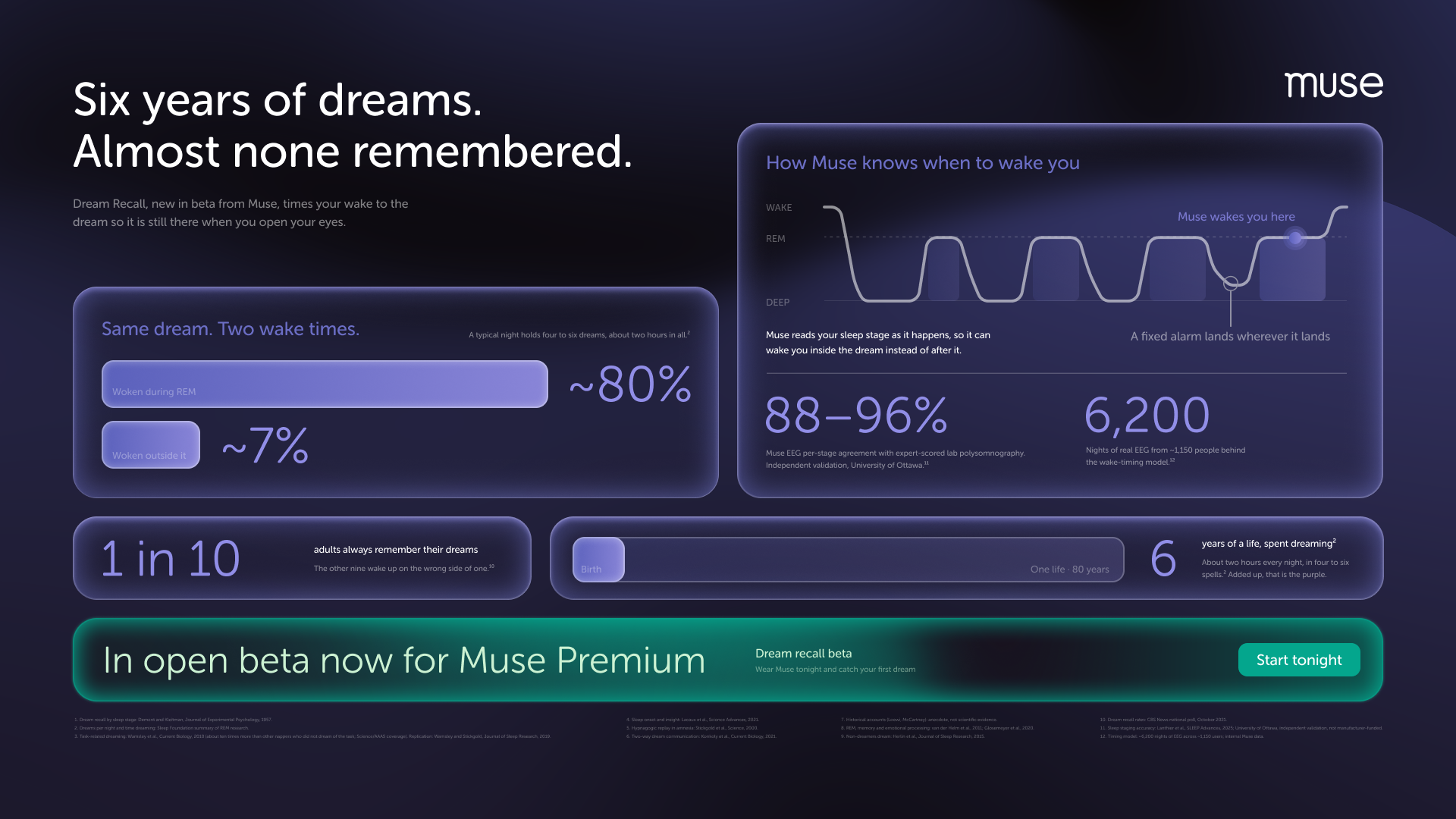
Muse reads sleep directly from the brain, not inferred from movement or heart rate the way a wrist or a ring does. That staging has been independently validated against a clinical sleep study at the University of Ottawa, in research Muse did not fund, at 88 to 96 percent per-stage agreement with expert-scored polysomnography. Because Muse knows which stage you are in as it happens, it can act at the right moment instead of the approximate one.
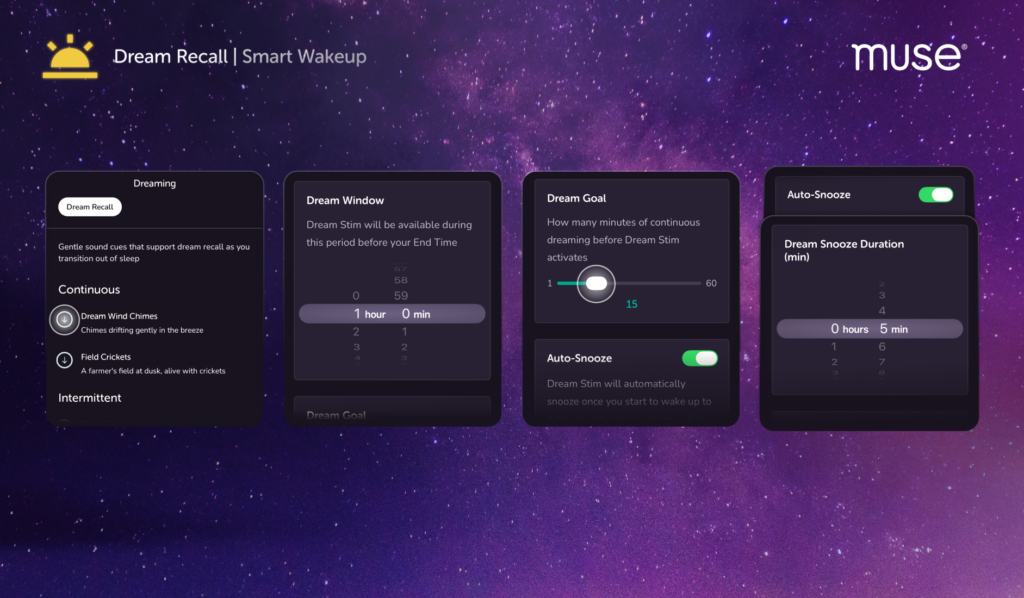
Dream Recall uses that precision three ways:
- It times your wake to a dream, so more of it remains to recall.
- Auto-Snooze steps the sound back as you begin to surface and holds you at the edge of sleep, so you can slip back into the dream instead of losing it.
- A sound cue, rehearsed while you are awake, can travel with you into the dream and become a signal you recognize inside it.
Dream Recall extends Sleep, by Design, the Muse toolkit built on the same staging precision: Sleep Assist helps you fall asleep faster, Deep Sleep Boost strengthens slow-wave sleep, and Smart Wakeup wakes you at the lightest moment of your final cycle.
“We have been working on the sleeping brain for years, and the science and the appetite around dreams have arrived at the same time,” said Chris Aimone, Co-Founder and Chief Innovation Officer at Muse. “Dreams do not belong on the esoteric shelf. We are excited to see what people do with their dreams once they can hold onto them.”
Why now
Sleep is no longer the soft corner of health. In the past two years, pharma has put billions into sleep-stage programs and hundreds of millions into at-home EEG. Nearly all of it measures sleep to report it back the next morning. Muse measures it to act on it, live, from the brain. Dream Recall makes that possible.
Dreams, in numbers
- 4 to 6 dreams in a typical night.2
- ~2 hours of every night spent dreaming; roughly six years of a life.2
- 1 in 10 adults say they always remember their dreams.10
- ~80% vs ~7% odds of recalling a dream when woken during REM versus outside it.1
- 3x more likely to solve a hidden-rule puzzle after one minute at the edge of sleep.4
- 10x greater improvement on a task after dreaming about it.3
- 88 to 96% Muse EEG per-stage agreement with expert-scored lab polysomnography.11
- 6,200 nights of EEG behind the Muse wake-timing model.12
Availability
Dream Recall is in beta now, available to current Muse Premium subscribers with a Muse S or Athena in the Muse app. Sleep Assist and Deep Sleep Boost are included free with every Muse S device. Learn more at choosemuse.com.
Muse is pioneering brain health through its industry-leading mEEG platform, built on advanced AI algorithms. Muse spearheads decentralized research initiatives focused on enhancing mental health, optimizing sleep, and advancing cognitive performance through innovative neurotechnology. Muse’s AI-driven tools empower researchers, developers, and consumers worldwide, and are underpinned by 200+ third-party-led studies from institutions including the Mayo Clinic, MIT, and Harvard. Muse has collected and decoded over 1 billion minutes of brain data to date, comprising one of the largest at-home EEG datasets in the world. Muse is headquartered in Toronto, Canada.
press@choosemuse.com
courtneyhiggins@maxborgesagency.com