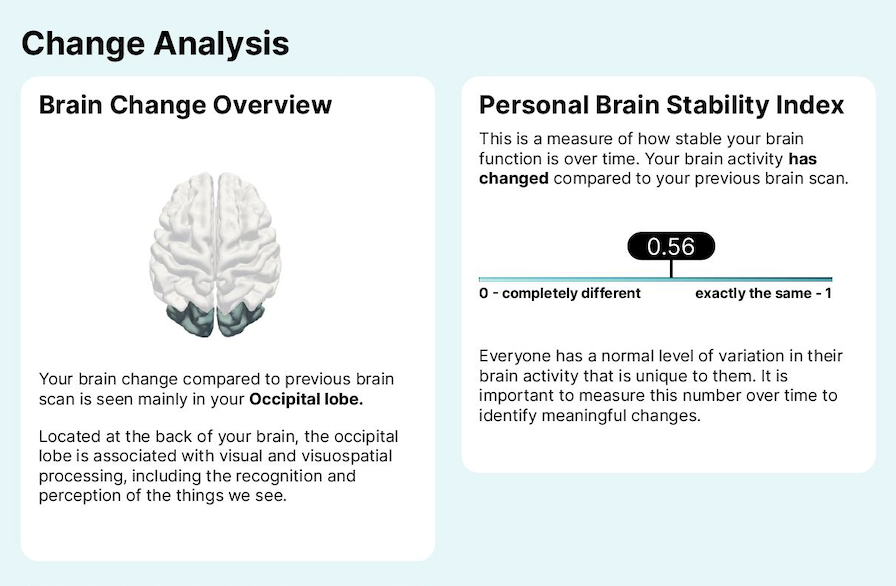
MYndspan (www.myndspan.com), a brain health technology company expanding access to magnetoencephalography, today announced the publication of a new preprint introducing the Brain Stability Index, or BSI, a research metric designed to quantify how similar an individual’s functional brain-activity patterns remain across repeated MEG scans.
The paper, Quantifying Neural Stability: Validation of a New Brain Stability Index, addresses a fundamental challenge in longitudinal brain measurement: how to distinguish an individual’s characteristic pattern of neural activity from the normal variation that occurs between scans.
Read the preprint:
Quantifying Neural Stability: Validation of a New Brain Stability Index
Most neuroimaging measures describe the brain at a single point in time or compare an individual with a population reference. The BSI instead focuses on within-person measurement, comparing a person’s current functional brain pattern with their own previous scan.
“Brain function is not static, and no two measurements will be perfectly identical,” said Dr. Benjamin Dunkley, Chief Scientific Officer at MYndspan. “The Brain Stability Index gives us a structured and interpretable way to express how similar a person’s whole-brain activity remains across time. Just as importantly, it recognises that change is not automatically pathology and stability is not automatically health. The value of the measure is in quantifying the difference so it can be studied in the appropriate context.”
The current BSI is derived from resting-state MEG recordings. Each scan is represented using ‘brain waves’ (or neural oscillations in neuroscientific terms) measured across 78 brain regions and five frequency bands, delta, theta, alpha, beta and gamma brain waves. The methodology reduces these measurements into the features that best capture meaningful differences between whole-brain patterns of activity. It then converts the similarity between two scans into a score between 0 and 1.
A higher BSI means that a person’s brain activity patterns are more similar to those seen previously, while a lower BSI means they have changed more. A BSI of 0.5 represents the level of similarity typically seen between two different people. Using precise mathematical simulations, the preprint investigated the ability of BSI to measure differences in brain activity that can occur from day to day. The analysis showed that, despite some unavoidable variation in MEG measurements, the technique can still reliably identify changes in brain activity within the same person over time.
“We routinely track changes in areas such as cardiovascular health, sleep and physical performance, but brain function is still often treated as a one-off snapshot,” said Caitlin Baltzer, Co-Founder and CEO of MYndspan. “Publishing the methodology behind the Brain Stability Index is an important step toward building a personal history of brain function, and one that can become more informative as additional measurements are added. It is not about labelling a brain as good or bad. It is about making change visible and measurable.”
The researchers believe the BSI could provide a foundation for future longitudinal studies examining brain activity during aging, recovery after injury, the progression of neurological and psychiatric conditions, and responses to treatment. Further research will be needed to evaluate the measure in each of these settings.
The BSI is not a diagnostic measure and does not determine whether a brain is healthy or unhealthy. It is not intended to identify the cause of a change, diagnose a neurological condition or guide treatment and return-to-play decisions.
MYndspan plans to continue evaluating the metric across larger and more diverse datasets, including longer follow-up periods and different research populations. The manuscript is available as a preprint and has not yet undergone peer review.
Read the preprint:
Quantifying Neural Stability: Validation of a New Brain Stability Index
MYndspan is on a mission to improve access to preventive and proactive brain health and is the first company in the world to bring non-invasive Magnetoencephalography (MEG) technology directly to the consumer. MEG is typically only accessible in research and specialist clinical settings and is the most advanced method of recording and evaluating the brain while it is actively functioning.
MYndspan’s brain health assessment technology is informed by 35 years of research and over 300 peer-reviewed studies. Its goal is to become a standard preventive health measure for monitoring and improving cognitive function, enabling earlier detection of neurodegenerative conditions and functional abnormalities linked to trauma, stress, or mental health disorders such as depression and PTSD.
Learn more at: www.myndspan.com
jeff.angus@myndspan.com
MYndspan