After a bad night of sleep, the brain doesn’t catch up by sleeping longer. It catches up by sleeping differently. That is the central finding of a new analysis released today by Muse, the brain health platform behind one of the world’s largest at-home EEG datasets.
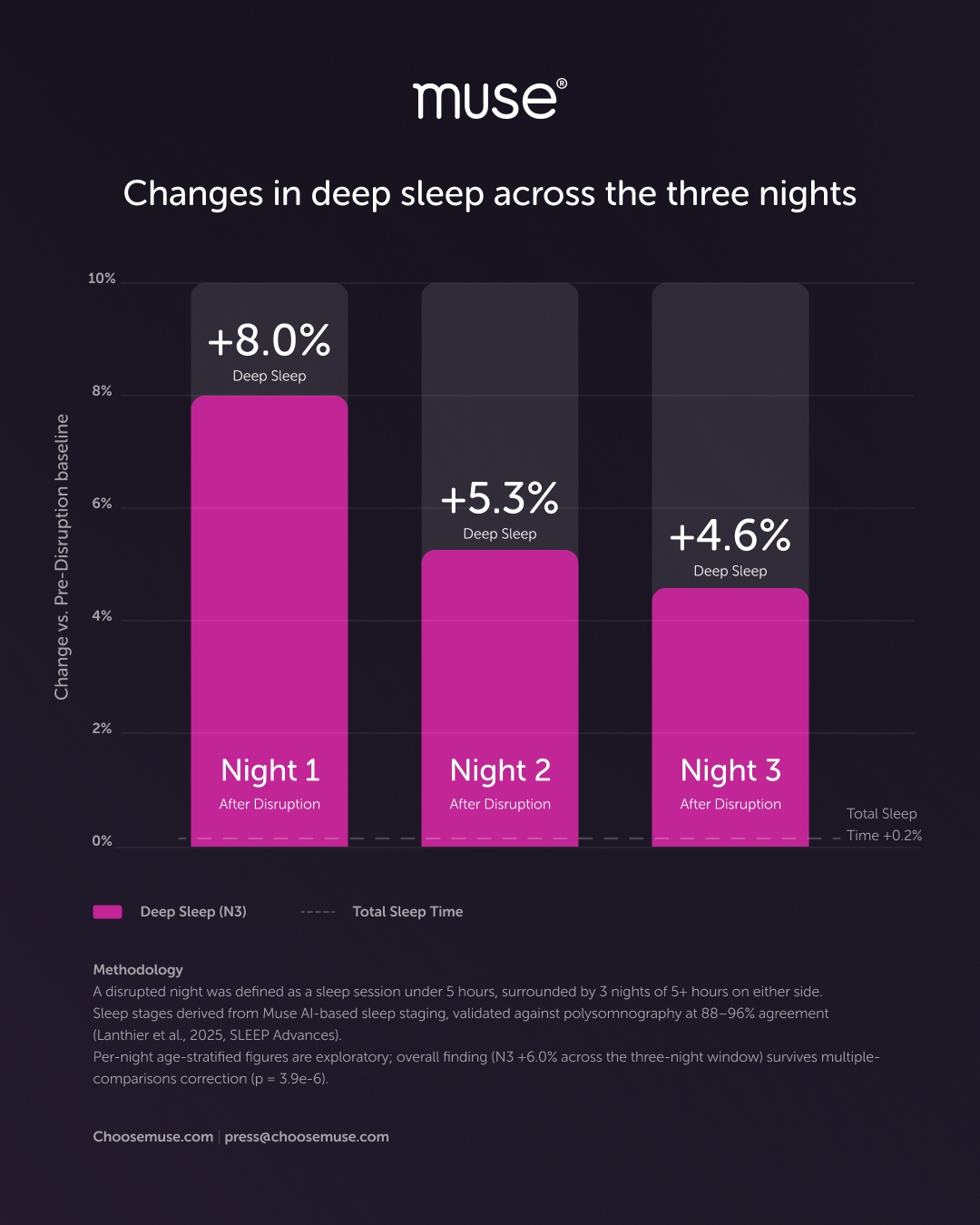
Drawing on 1,846 disrupted nights from 868 Muse users, the analysis finds that a single short night triggers a recovery response that unfolds across three consecutive nights — with deep sleep rising on each one, REM deferred, and total sleep time barely changing. The brain rebuilds the architecture of sleep within the same window of time.
Sleep stages were derived using Muse’s AI-based sleep staging. Muse’s AI sleep staging capabilities were independently validated against polysomnography at 88–96% agreement (Lanthier et al., 2025, SLEEP Advances).
The Three-Night Recovery Arc
In the analysis, a disrupted night was defined as any sleep session under five hours, surrounded by three nights of five or more hours on either side. The team then compared the three nights before and the three nights after each disruption.
Across the three recovery nights, deep sleep rose by approximately 8.0% on night one, 5.3% on night two, and 4.6% on night three. Total sleep time across the three-night window changed by just 0.2%.
On the first recovery night, sleep was longer (+1.3% total sleep time), more efficient (+0.7 percentage points), and less broken (−6% time awake after sleep onset). REM sleep was deferred: the time it took to enter REM rose 3.5%, and the share of the night spent in REM dropped 2.3 percentage points.
The pattern is consistent with a known mechanism in sleep biology — the brain prioritizes deep slow-wave sleep before it restores REM — but the scale and timeline of the response, observed across hundreds of nights of at-home data, has not been quantified at this size before.
“Most people assume one bad night is a one-night problem,” said Dr. Walter Greenleaf, Neuroscientist and Digital Health Expert, Stanford University. “What this data reveals is that the brain is still reorganizing its sleep architecture two and three nights later — not by sleeping longer, but by sleeping differently. And you can only see that with EEG.”
How Recovery Changes With Age
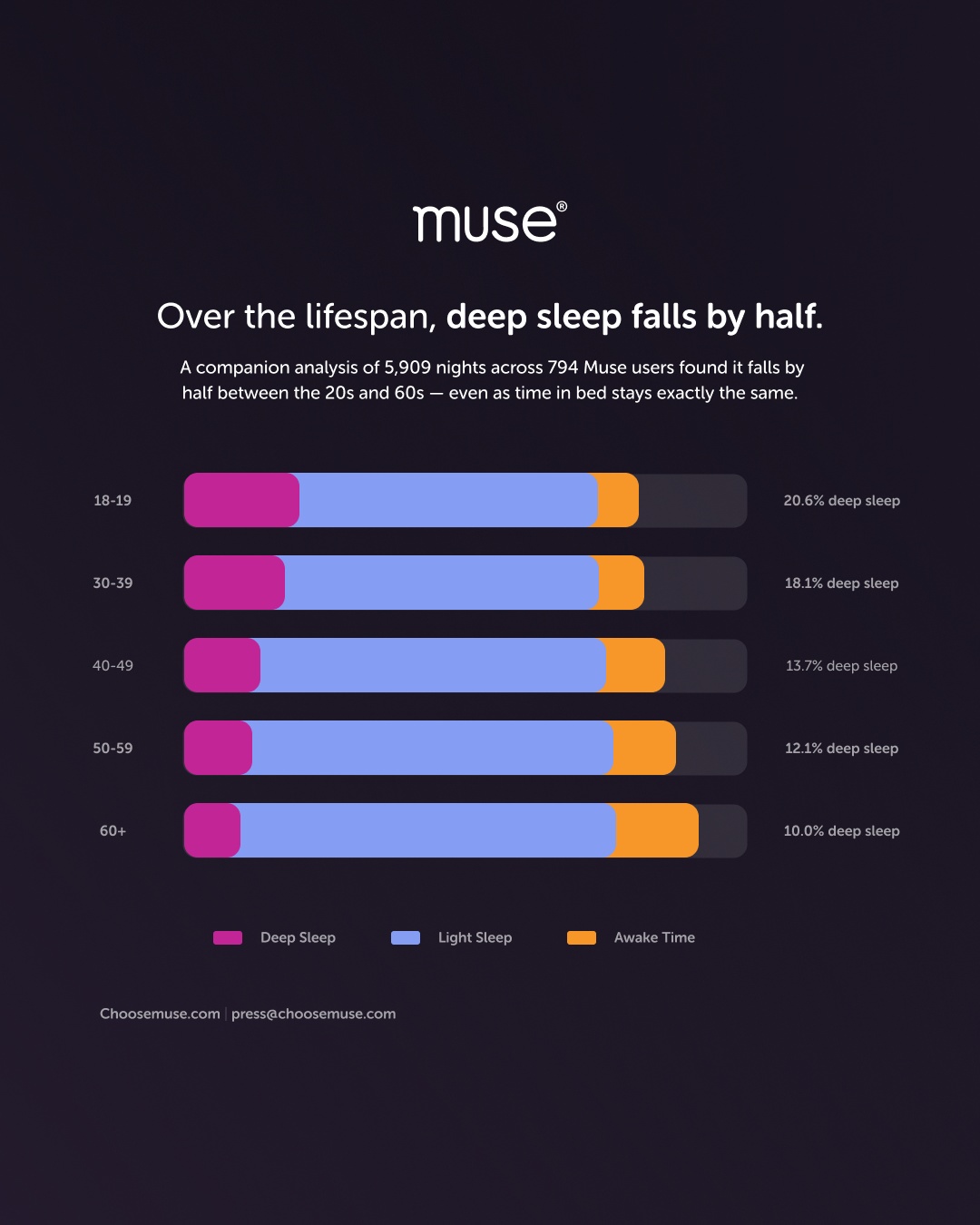
It is well established that deep sleep declines with age. What is less understood is the scale. A companion analysis of 5,909 nights across 794 Muse users found it falls by half between the 20s and 60s — even as time in bed stays exactly the same.
The recovery findings take on added significance in that context: the brain is rebuilding a resource that is already shrinking. The analysis found three different recovery strategies across the lifespan:
- Sleepers under 40 compensated by sleeping longer on the first recovery night (+3.2% total sleep time), not by sleeping deeper. Their baseline deep sleep was already high enough that there was little room for it to rebound.
- Sleepers between 40 and 60 showed the most pronounced and sustained deep sleep response, with the rebound persisting across all three recovery nights.
- Sleepers 60 and older showed a broad rebound on the first night that did not extend to the second.
Across all groups, the night-to-night variability of deep sleep increased after a disruption — by approximately 9% overall. Recovery is elevated, but it is also less stable.
“What the data shows is that recovery isn’t one event. It’s a sequence,” said Chris Aimone, Co-Founder and Chief Innovation Officer of Muse. “The brain pays the deep sleep debt first, and it does it within the same hours in bed. You can only see that pattern with EEG, and you can only see it clearly when you’re measuring tens of thousands of nights at home.”
Why This Matters for the Sleep Wearable Category
Most sleep wearables measure movement and heart rate. These signals are useful proxies, but they cannot directly observe deep sleep, slow-wave activity, or the recovery hierarchy described in this analysis. The findings required EEG measurement at scale across thousands of at-home nights.
Muse’s Deep Sleep Boost — a feature that delivers EEG-timed acoustic cues during slow-wave sleep — is built directly on this physiology. In Muse’s internal data, users showed 24% longer slow-wave trains, 42% more slow-wave trains per minute, and 76% more slow waves in organized trains.
Deep Sleep Boost is included with all Muse S models at no additional cost. The Muse S Athena is available at choosemuse.com and select retailers.
For Media
High-resolution hypnograms, age-stratified data visualizations, and the full methodology brief are available on request.
Muse is pioneering brain health through its industry-leading mEEG platform, built on advanced AI algorithms. Muse spearheads decentralized research initiatives focused on enhancing mental health, optimizing sleep, and advancing cognitive performance through innovative neurotechnology. Muse’s AI-driven tools empower researchers, developers, and consumers worldwide, and are underpinned by 200+ third-party-led studies from institutions including the Mayo Clinic, MIT, and Harvard. Muse has collected and decoded over 1 billion minutes of brain data to date, comprising one of the largest at-home EEG datasets in the world. Muse is headquartered in Toronto, Canada.
press@choosemuse.com
Muse by Interaxon Inc.