Muse, the brain-health wearable company, today published a new analysis of its at-home EEG data showing that the most consistent practitioners in their 60s and 70s outperformed sporadic practitioners three decades younger on a demanding attention test. Across 189 users, how regularly people trained mattered more than their age or their total practice time.
After a certain age, the brain’s split-second ability to override an automatic response, known as cognitive control, begins to slip. The new analysis is the latest in a series drawing on one of the world’s largest at-home EEG datasets. Muse uses EEG and a foundation model to estimate brain age from resting brain rhythms; in the company’s analyses, those estimates land within about ±7 years of chronological age, matching peer-reviewed work using Muse recordings (Banville et al., 2024, Imaging Neuroscience). The broader set of recordings let Muse ask a harder question. In everyday behavior, what tracks with a brain that reads younger than its years?
The analysis draws on two things, what people did and how sharp they were. The habit was biofeedback training on the Muse headband, roughly 53,000 sessions logged across 189 users aged 31 to 83 over the year. The measure was cognitive control, assessed through 1,228 completions of the same Stroop attention test. Across every age group measured, users who trained in most weeks were 40 to 50 milliseconds faster at dealing with conflicting information than those who trained sporadically.
“What’s striking is how steadily this held across the whole age range. The people who practised regularly kept their edge on a demanding attention task, and the most consistent older adults matched younger ones. That’s the kind of real-world pattern that becomes visible when thousands of at-home sessions are studied over time.” — Dr. Walter Greenleaf, Neuroscientist and Digital Health Expert, Stanford University
The attention test was a Stroop task: users see a color word printed in a mismatched ink, such as the word red in blue, and must name the ink while pushing past the automatic urge to read. The extra time that conflict costs, measured in milliseconds, is a clean read on cognitive control. What mattered was not how many total minutes people logged, but how regularly they showed up. Consistency, not volume, carried the association (β = −54 ms, p = 0.048).
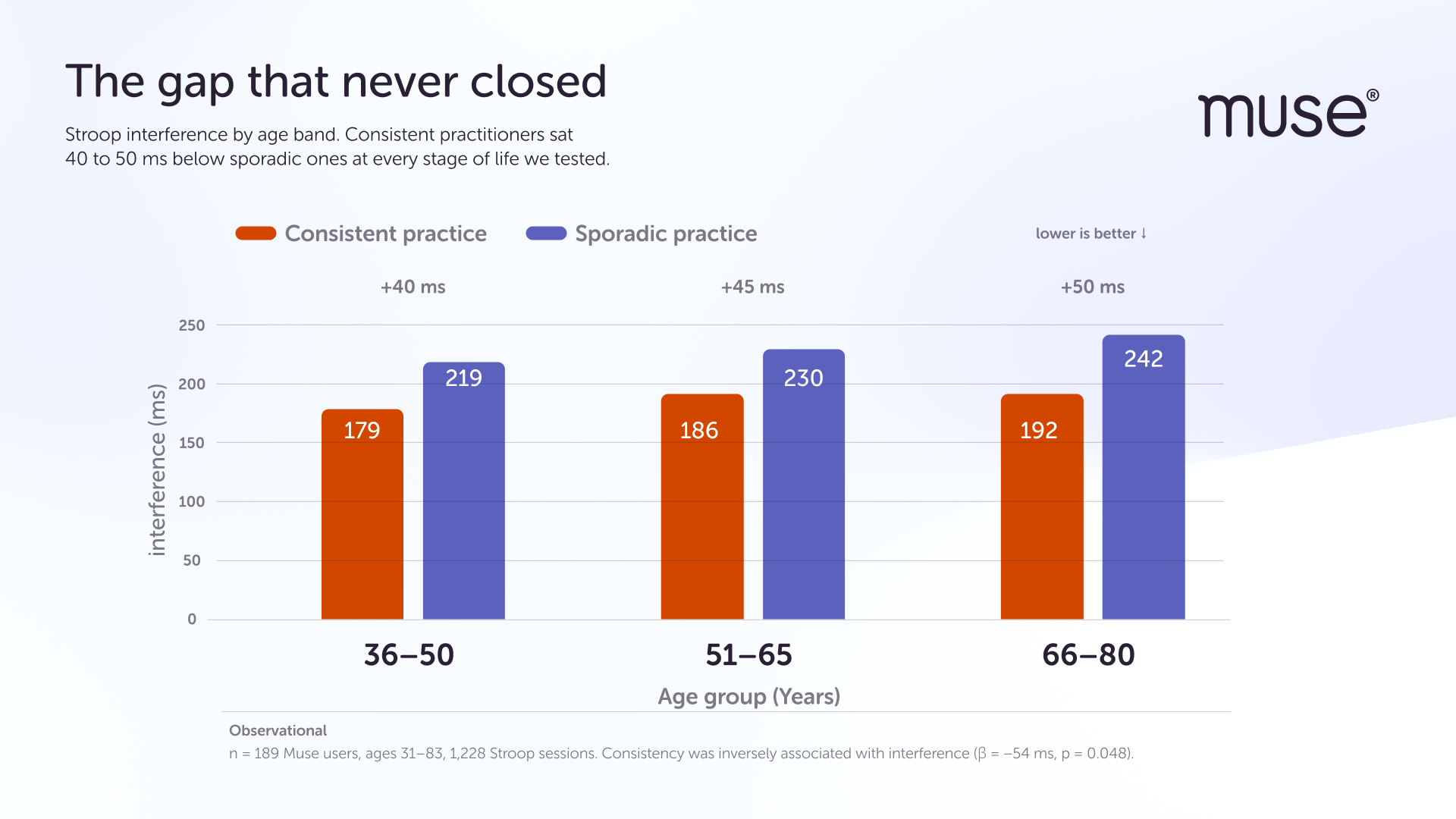
Consistent practitioners in their 60s and 70s averaged 192 milliseconds of interference, which is the additional response time caused by conflicting word and color information. Sporadic practitioners in their 30s and 40s averaged 219. On this test, regularity outran age by three decades.
The analysis is observational. People choose their own habits, so it points to an association, not proof that training sharpens attention, and it makes no medical claim. People who practise consistently may also differ in other healthy habits, which the analysis can’t rule out. The pattern itself is steady, though. The regular-practice edge showed up in every age group in real-world data.
Cognitive control is one aspect of cognitive aging. Brain age offers a broader view by estimating age-related patterns in resting EEG, and peer-reviewed work using Muse recordings (Banville et al., 2024) found that those estimates can shift over time with factors such as sleep, state, and recent rest.
“Brain age takes something abstract and puts it in a number people already understand, how old your brain seems next to the calendar. The research shows it’s measurable, and that it changes over time. And now we’re seeing ordinary habits, like how regularly someone practises, show up in how the brain ages. To me, that’s what makes it worth tracking.” — Chris Aimone, Co-founder and Chief Innovation Officer, Muse
Muse is now bringing brain-age tracking into its app experience, so members can follow the same measure over time.
Want to train your brain and track your progress over time? The Muse S Athena and Muse 2 headbands are available at choosemuse.com.
For Media
Age-stratified data visualizations, the full methodology brief, and interviews with Muse spokespeople are available on request. Contact press@choosemuse.com.
*Findings are observational, drawn from a self-selected cohort of 189 Muse users, and correlational, not evidence of a causal, therapeutic, diagnostic, or efficacy effect. Brain-age estimates carry a typical error of about ±7 years. Source: Muse cognitive-aging analysis; peer-reviewed brain-age validation from Banville et al., 2024, Imaging Neuroscience (doi.org/10.1162/imag_a_00189).
Muse is pioneering brain health through its industry-leading mEEG platform, built on advanced AI algorithms. Muse spearheads decentralized research initiatives focused on enhancing mental health, optimizing sleep, and advancing cognitive performance through innovative neurotechnology. Muse’s AI-driven tools empower researchers, developers, and consumers worldwide, and are underpinned by 200+ third-party-led studies from institutions including the Mayo Clinic, MIT, and Harvard. Muse has collected and decoded over 1 billion minutes of brain data to date, comprising one of the largest at-home EEG datasets in the world. Muse is headquartered in Toronto, Canada.
press@choosemuse.com
Muse by Interaxon Inc., Toronto, Canada