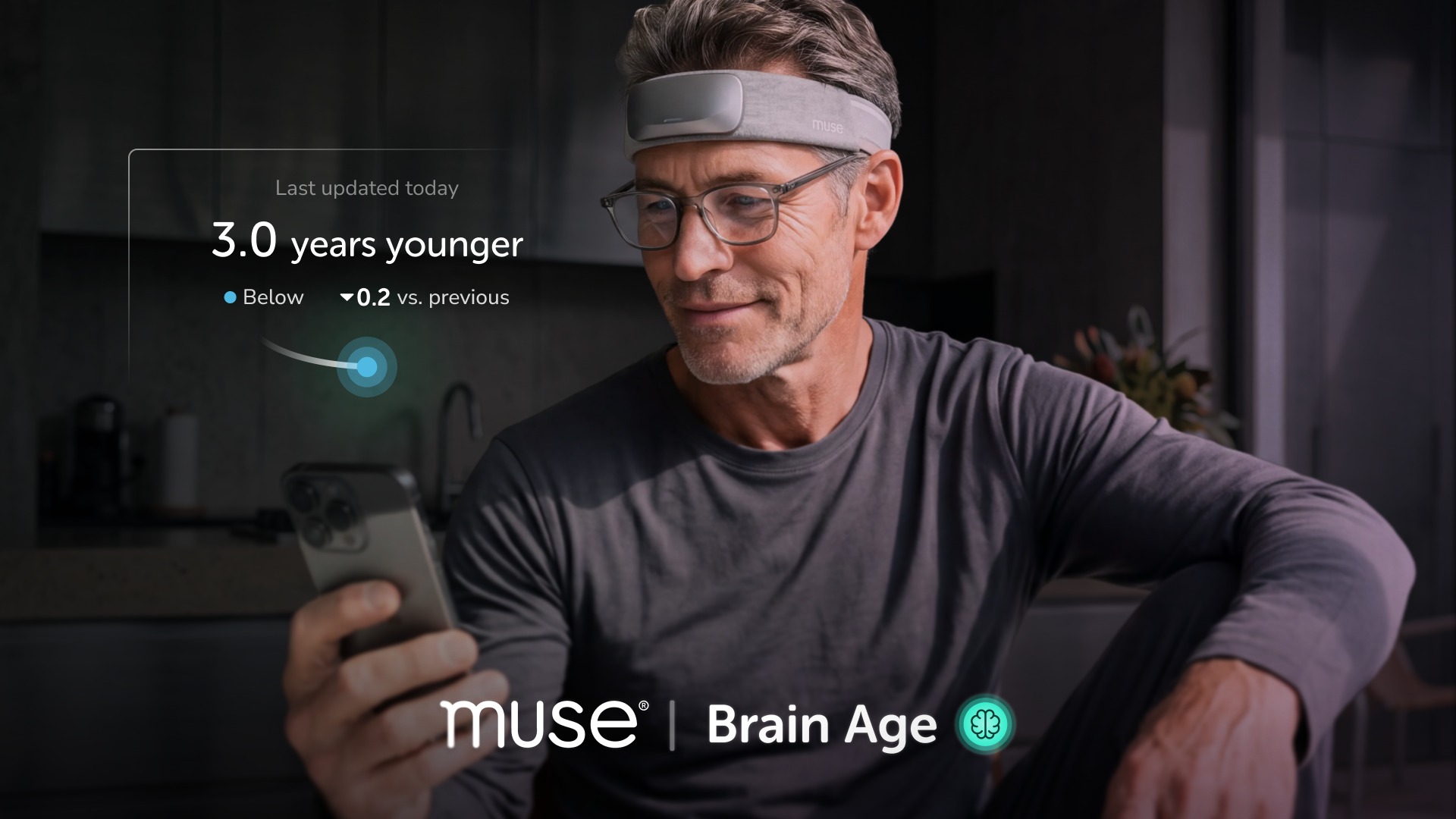
Muse today announced Muse Brain Age, a weekly measure of how old a person’s brain appears relative to their actual age. It is the only consumer brain age measure derived from direct brain activity, developed from peer-reviewed research published in Imaging Neuroscience. Muse Brain Age begins rolling out in the Muse app for iOS and Android on October 19 on Muse 2, Muse S and Muse S Athena, and every user’s first reading is free.
In the Alzheimer’s Association’s 2026 Facts and Figures report, 99% of American adults aged 40 and older said brain health matters at least as much as physical health. Only 9% said they knew a lot about how to take care of it.
Muse has spent over a decade building tools for exactly that, and Brain Age is the next step.
Biological age has become one of the defining consumer health metrics of 2026, and watches, rings and smart beds estimate how old the body is from heart rate, heart rate variability, VO2 max and sleep. None of them can describe the brain. Reading the brain takes EEG, sensors on the head that pick up its electrical activity directly.
Muse Brain Age measures the one organ the others cannot reach.
What is brain age?
Brain age is an estimate of how old a brain appears from patterns in its activity, compared with the person’s actual age. The difference between the two, known as the brain-age gap, has been studied for more than a decade, mostly with MRI. Muse Brain Age brings that measure to EEG recorded at home.
“Brains do not age on a schedule. Two people at fifty can have brains that look years apart, and neither of them would know it,” said Nadia Kumentas, Chief Product and Marketing Officer of Muse. “Everyone accepts that bodies change with age, which is why strength and cardiovascular fitness get tracked more closely over time. The brain deserves the same attention, and Brain Age makes it something people can actually watch.”
What does a Muse Brain Age reading show?
A Muse Brain Age reading is a difference in years. It might come back three years younger than a person’s actual age, or two years older. Muse reports the difference rather than an absolute age, because the difference is the part that carries meaning: it answers where you stand relative to your age. In evaluation against people who had no part in building the model, Muse Brain Age estimates differ from chronological age by about 3.8 years on average, and an individual’s weekly reading typically moves by about 1.9 years from one week to the next.
Two contributors go into that reading:
- Daytime EEG is the brain’s own activity, recorded during regular Muse sessions through four dry sensors, on the forehead and behind the ears.
- Cognitive Performance is four short tests: processing speed, spatial memory, impulse control and selective attention. Each test reports its own score, so a person can see which one changed.
The recording happens during sessions people are already doing. A first reading draws on eyes-closed Muse sessions totaling at least 10 minutes across 7 different days, plus the four cognitive tests. After that, sessions on 3 days a week keep it current, and each Monday reading is updated from the previous week’s sessions.
A single reading gives a person a starting point. Six months of readings gives them a trajectory. Brain age research has relied on MRI, which means a scan every few years at best. A weekly reading at home needs no clinic and no scanner.
Grounded in peer-reviewed research on more than 5,200 at-home recordings
Muse has recorded more than a billion minutes of EEG in people’s homes since 2014. In 2024, Muse researchers and collaborators used that data to ask whether four dry sensors could estimate brain age at all. A peer-reviewed study in Imaging Neuroscience of more than 5,200 at-home recordings from users aged 18 to 81 showed they could, within the range reported for laboratory-grade equipment. The signal sits in rhythms such as alpha, which shift as people age.
Muse Brain Age is what that result became. The 2024 study used a model with about 3,300 parameters; Muse Brain Age uses one with 300 million, about 90,000 times more. On people whose data was not used to build it, the EEG model reduced mean absolute error by 47% against the 2024 model, and adding the cognitive tests cut the remaining error by a further 13%. The size matters because no two brains age the same way, and a model that large can hold that variation instead of averaging it away. Most brain age research has relied on measurements taken years apart, which shows where a person is but rarely how they got there. A weekly reading at home turns that snapshot into a line.
“The brain’s rhythms shift slowly across adulthood. Alpha, one of the strongest, gradually gets slower, and my lab spends a lot of time working out why,” said Dr. John Griffiths, Research Scientist at CAMH and Assistant Professor at the University of Toronto. “Those changes unfold over years, and any single reading also moves with how rested or stressed you are. Measuring every week, over months and years, is how you would start to see the longer trend.”
Muse Brain Age is not a diagnostic test and does not detect, predict or rule out any medical condition, including cognitive decline or dementia.
Availability
Muse Brain Age starts rolling out on October 19 and reaches all users by October 26. It works with Muse 2, Muse S and Muse S Athena. Every user gets their first reading free. Continued weekly readings, full history and contributor detail are included with Muse Premium, available bundled with Muse 2 ($309) or Muse S Athena ($539). Learn more at choosemuse.com/pages/brain-age. Samples, imagery and interviews are available on request.
Muse makes EEG brain-sensing wearables and the software that turns brain activity into measures people can use at home. For over a decade, Muse has shipped more than 500,000 devices, built one of the world’s largest at-home EEG datasets, and supported more than 200 third-party-led studies from institutions including the Mayo Clinic, MIT and Harvard. Muse was named to TIME and Statista’s World’s Top HealthTech Companies 2026. Muse is headquartered in Toronto, Canada.
Muse Brain Age is a general wellness feature. Muse is not a medical device.
Data note: Brain Age is computed in Muse’s own systems, and the app receives only the resulting reading. The model behind it is an internal research system trained on curated, de-identified EEG, as described in Muse’s Privacy Policy. Muse does not sell brain data.
press@choosemuse.com
courtneyhiggins@maxborgesagency.com