
Physicians are all-in on AI.
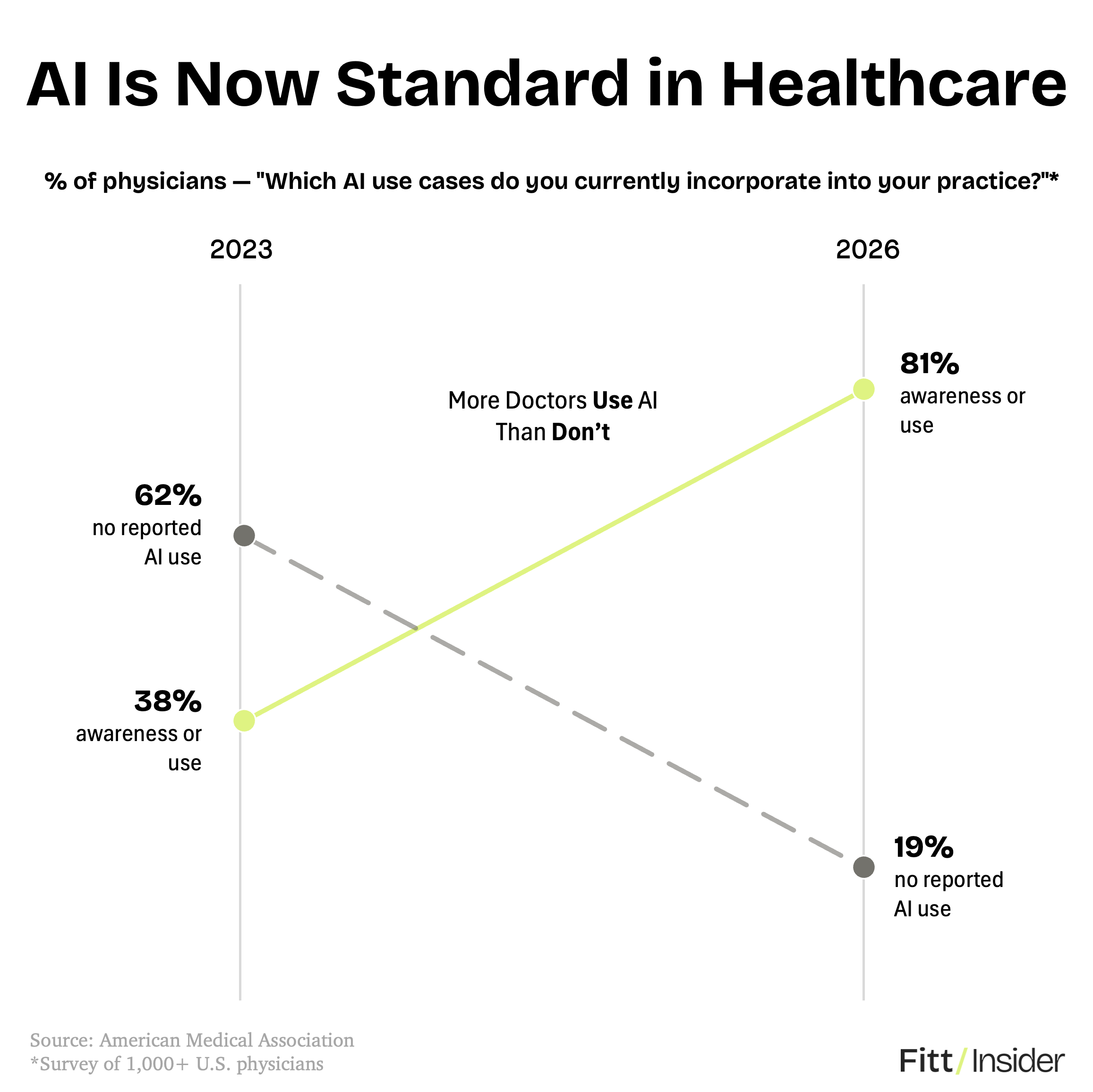
Standard care. AI use among US doctors hit 81% in 2026, up from 38% in 2023, while non-use fell from 62% to 19%, according to the American Medical Association. Weekly usage is now routine, with clinicians averaging 2.3 AI use cases, up from 1.1.
Toolkit. As adoption surges, clinical AI is becoming a new battleground.
Entering the race, OpenAI launched ChatGPT for Clinicians free for US providers, supporting documentation, research, and care workflows — as AI usage becomes the default. By going direct—and free—OpenAI is seeding distribution to lock in clinicians and compete with doctor-focused tools like OpenEvidence, which is valued at $12B.
Workflow. Targeting burnout and admin overload, doctors are delegating busy work, not diagnoses. Nearly 40% of physicians use AI for research summaries, with rapid growth in documentation — discharge notes, charting, and billing.
A positive, 76% of physicians say AI improves patient care. But 88% are concerned about the risk of skill loss, and privacy remains the top barrier to deeper integration. Not a plug-and-play, even medicalized LLMs alleviate burden disproportionately across specialties.
Punchline: AI in healthcare has reached a tipping point. As adoption scales, the battle shifts from model quality to owning the clinical workflow — and the clinician relationship.




![ANIMAL [a listening gym] installation](https://insider.fitt.co/wp-content/uploads/2026/08/ANIMAL-Exhibit-e1786733524804-768x512.png)