Wearables want to be the front door to care.
Worn In
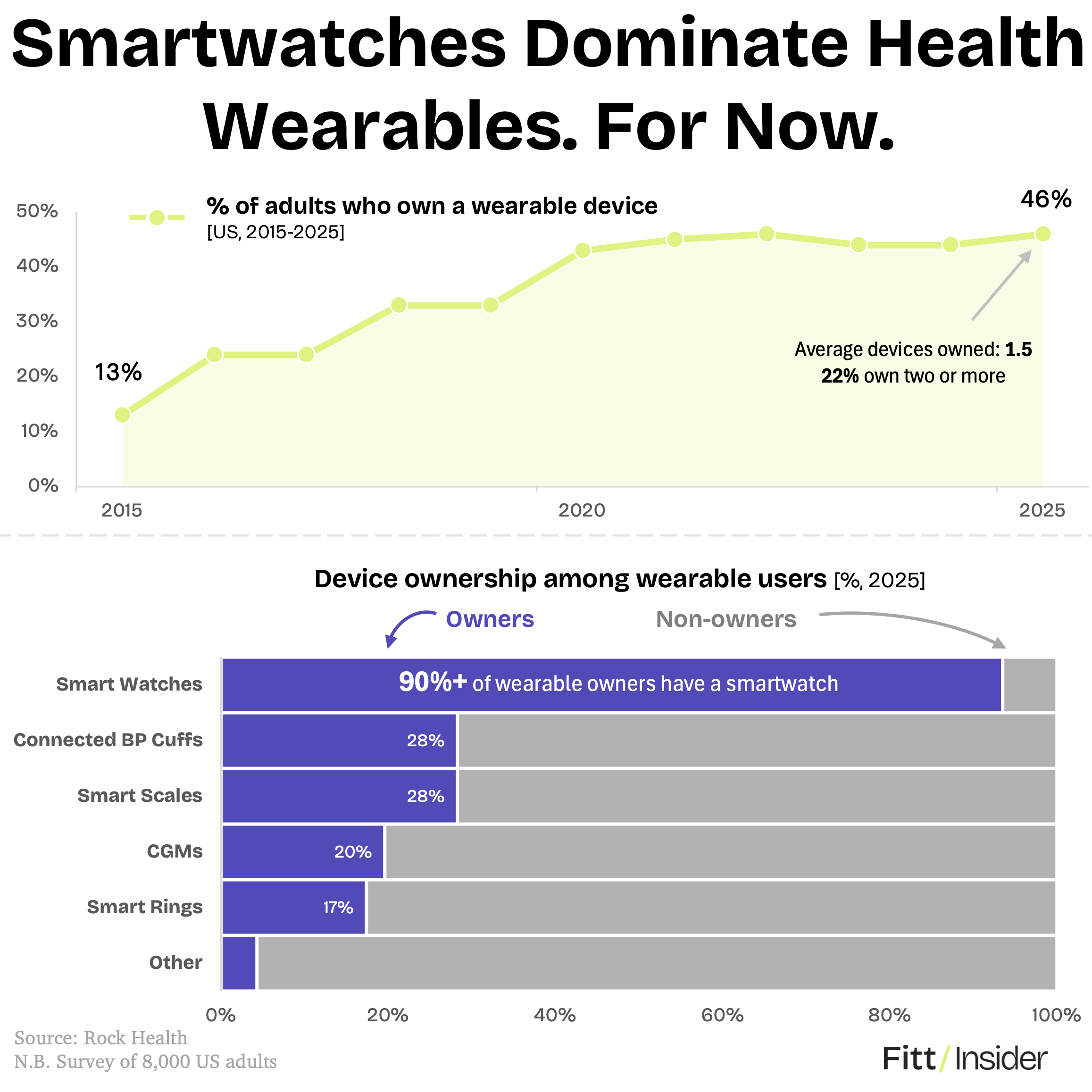
Up from 13% in 2015, nearly half of Americans now own a wearable. The most popular form factor, 93% have smartwatches vs. 18% with rings, and 22% use two devices, per Rock Health.
Beyond fitness tracking, most wear gadgets continuously, and 59% have discussed the data with their doc.
Power users. Taking a DIY approach, wearable owners are self-navigators — 74% use health apps, 44% use AI chatbots, and 41% use DTC test kits. Young, wealthy optimizers lead adoption, with 76% of users under 44.
Systems Thinking
Consumer-first and longevity-focused providers are more likely to leverage wearable data, while legacy systems are slowed by bureaucracy and fragmented EHRs. Aiming to reach those most in need, wearables are evolving from siloed hardware to care infrastructure.
Notably, WHOOP’s $575M raise included backing from Abbott and Mayo Clinic, ahead of launching in-app telehealth and making Medicare inroads via the CMS’s ACCESS program.
Meanwhile, Oura partnered with Counsel Health and Flexpa and acquired Galen AI to connect clinical records, labs, and meds to device data. Envisioning a “cloud of wearables,” the company filed for an IPO as a “global health intelligence” platform.
Wearable wars. Apple still leads the market, but stalled initiatives, internal restructuring, and regulatory caution are hindering its health ambitions. Jockeying for position, Fitbit debuted a subscription-free WHOOP rival, Garmin is growing but remains largely fitness-focused, and Samsung’s Galaxy Watch is gaining Vitals metrics x AI health coaching.
Bottom up. Wearables are rising as consumers bypass traditional healthcare. Disruptive teleproviders like Hims & Hers have altered acquisition funnels, turning patients into shoppers.
From alternative insurance to full-body checkups and medical tourism, Americans are building a bottom-up system, rather than awaiting top-down change. Partnering across healthcare, wellness, and sport, wearable makers want to power it with a Personal Health OS.
Looking ahead: Piecing together biometrics, bloodwork, AI advising, and access to MDs, wearables already won over high-agency, tech-forward consumers. The next challenge is reaching the average person with low-touch, high-signal clinical insights.