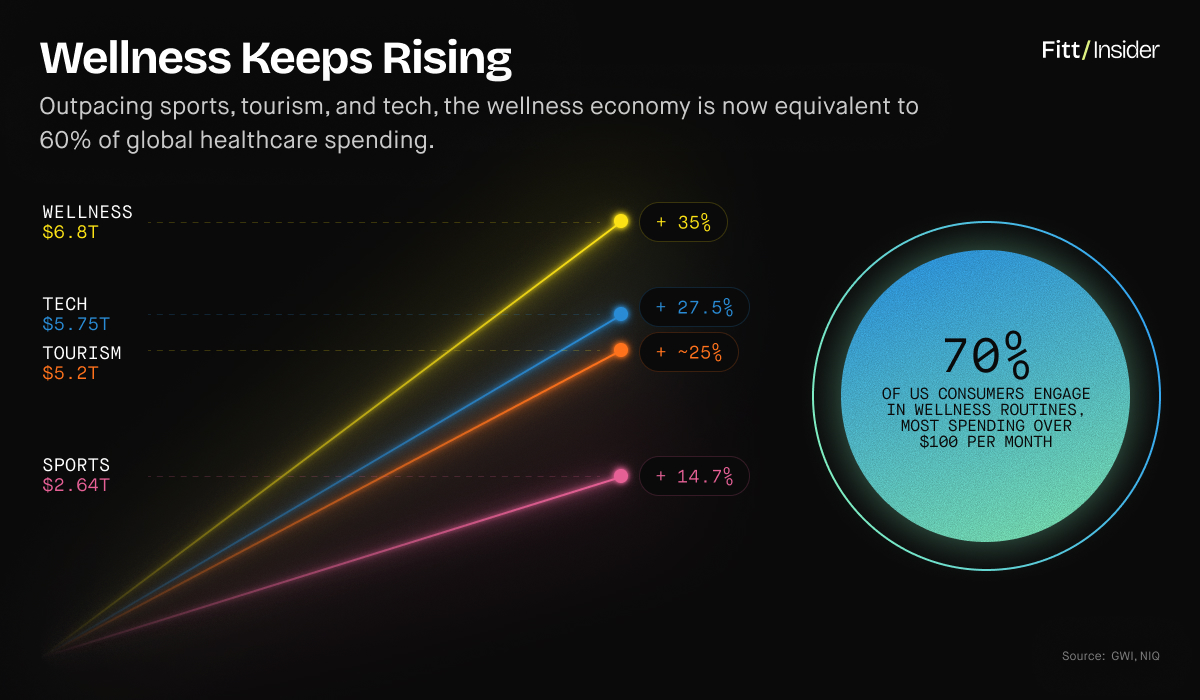
Wellness is inescapable. Up 35% since 2019, it’s now worth $6.8T. Outpacing sports, tourism, and tech, it’s equivalent to 60% of global healthcare spending.
But 2025 wasn’t just a growth story; it was a year of transformation — with wellness becoming core to the cultural lexicon. From GLP-1s to wearables, gyms, CPG, healthtech, activewear, and beyond, here are the moments that mattered this year, and the macroshifts behind them.
GLP-conomy
Weight loss drugs were wellness’s black swan.
Putting obesity on the decline, GLP-1s are working, wanted, and will be the entry point for a new wave of wellness consumers. A feat of modern medicine, drugs don’t replace lifestyle habits but offer a much-needed lifeline for many. Securing celebrity spokespeople and cultural acceptance, they’re challenging longstanding beliefs about biology, agency, and willpower.
Altering gym programs, grocery lists, and even menopause care, weight loss drugs are increasingly accessible — with prices dropping as low as ~$150/month for forthcoming pills. But access and quality aren’t equal, creating a divide between brand-name users with concierge oversight vs. those navigating low-cost compounds or cycling on and off without guidance.

Telehealth was quick to adapt, with Ro, Hims, WeightWatchers, Noom, knownwell, and others marketing affordable microdoses and wraparound care to the masses. Translating blood sugar to real-time coaching, CGMs x digital twins are becoming the long-term lifestyle adherence layer.
Finding nuance, cultural conversations are shifting. Anti-diet dogma softened, body-neutrality rhetoric collided with pharma-driven results, and “strong not skinny” broadened to include people on medication. Lean muscle is becoming both functional and aesthetic goal, with body comp replacing BMI via scans like DEXA, Springbok Analytics, Bodd, and Evolt.
Full-stack fitness
Fitness facilities are becoming full-service longevity centers.
A $240B global industry in its own right, fitness is staying relevant by swapping vanity for holistic gains. Building behavioral bridges, the gym-as-clinic is positioning as a care hub for GLP-1 patients — many of whom are fitness foreigners needing guidance doctors can’t give.

Facing federal pushback, gyms can no longer rely on hard-to-cancel memberships, prompting Life Time, Equinox, and insurgent Monarch to scale the model for pharmaceutical-assisted fitness. Measurable results, not just vibes, are becoming the primary selling point.
Replacing piecemeal solutions, Everything Gyms are merging diagnostics, coaching, recovery, and community to support complete lifestyle makeovers. Women are all-in on strength, people are hyped on hybrid training for healthspan, and more are swapping burnout-inducing cardio for mind-body modalities like Pilates.
Outside the gym, movement is moving toward play, belonging, and story over metrics, a trend showing up in surging participation across run crews, trail culture, racket sports, surf parks, and thermal bathing. Valuing joy as a component of health, most want community and belonging, not optimization — particularly mental health-conscious Gen Z.
Sexual healing
Taboo topics have become innovation hotbeds.
As explored in our Sexual Wellness Report, men’s and women’s health are ripe for growth, respectively. From hormone therapies and fertility treatments to specialized care and clean hygiene products, the sector is a $115B goldmine finally seen as core to human flourishing.
The female health renaissance is in full force, with sportswear, supplements, training programs, and even resorts redesigning to support women through distinct life stages. Gaining 6K potential customers daily, the menopause market is in hypergrowth, and early leader Midi added $50M for next-gen care — layering longevity programs, supps, and AI into its ecosystem.
Beyond alleviating pain, companies are building solutions to help people maintain performance, purpose, and pleasure in midlife. While fertility care remains a hot topic, the broader trend of people opting out of marriage and kids calls for cultural, not just scientific, answers — bringing men’s well-being, family benefits, parental stress, and emotional intelligence into play.
As pelvic floor therapy, sex-specific protocols, and proactive reproductive care address long-ignored problems, women’s sports’ rise is drawing investments in preventative R&D — decoding female physiology x biomechanics to reduce injury.
Food fads
Ingredient fixation is the new diet culture.
Proof produce needs better PR, 60% of grocery dollars are spent on processed food and drinks, one in six American adults has diabetes, and one in three kids is pre-diabetic. Engineered to addict, hyperpalatable UPFs—comprising ~70% of US food supply—remain the biggest driver of metabolic decline.
MAHA made people aware yet confused, with 74% believing UPFs are harmful but just 11% confident of their definition. Stepping in, telenutrition platforms Nourish, Fay, and Berry Street all added funding in H1. In the works, companies are leveraging tech to personalize and democratize healthy meal delivery, aiming for end-to-end automated eating.
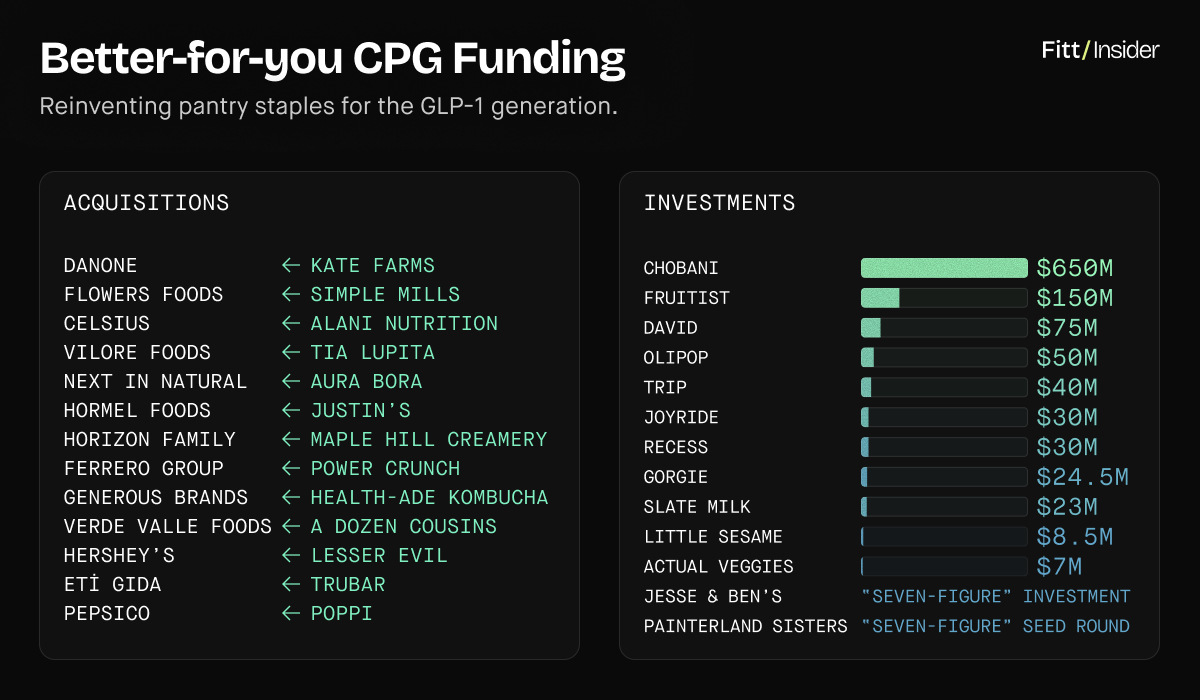
Redesigning snacks for the GLP-1 generation, CPG is protein-maxxing, and better-for-you keeps finding capital — from JOYRIDE’s junkless candy and Jesse & Ben’s seed oil-free fries to OLIPOP’s $1B+ alt soda and TRIP and Recess’s functional NA sips.
Buying in, Hershey acquired LesserEvil, Chobani took over Daily Harvest, Flowers Foods snagged Simple Mills, Ferrero Group closed on Power Crunch, and PepsiCo purchased poppi.
Logo wars
Selling an aesthetic without cultural currency is out of style.
A shift that has been brewing for years, activewear giants are slipping as their size becomes both economic moat and Achilles heel. Social media x social fitness have reshaped the space, and the new challenge for brands is preserving IYKYK energy while growing awareness.
For the Goliaths, interactive stores and activations are a strategy for rebuilding customer intimacy. While lulu landed in SoHo and popped up community classes, Nike launched its women’s race series, elite running program, and youth street soccer platform, plus a Lego playground, free public hub in London, and a Philly-based Jordan Brand flagship.
For the Davids, intentionality and cultural roots are everything — with On’s global avant-garde energy, Vuori’s sunny San Diegan perspective, Alo’s unapologetically LA approach, and Bandit’s NYC run club-embedded roadmap standing out. The category has become about story, legacy, and lifestyle, meaning performance fabrics must be woven by an authentic narrative.
Guerrilla healthcare
Personal health agency is a hill Americans are willing to die on.
Systemic disappointment spawned decentralized healthcare, anchored by solutions designed for end users over insurance companies. Seeking data ownership and n-of-1 insights, affluent consumers are trading traditional checkups for longevity clinics, DTC bloodwork, AI coaches, preventative scans, DIY supp stacks, grey-market peptides, and digital storefronts.
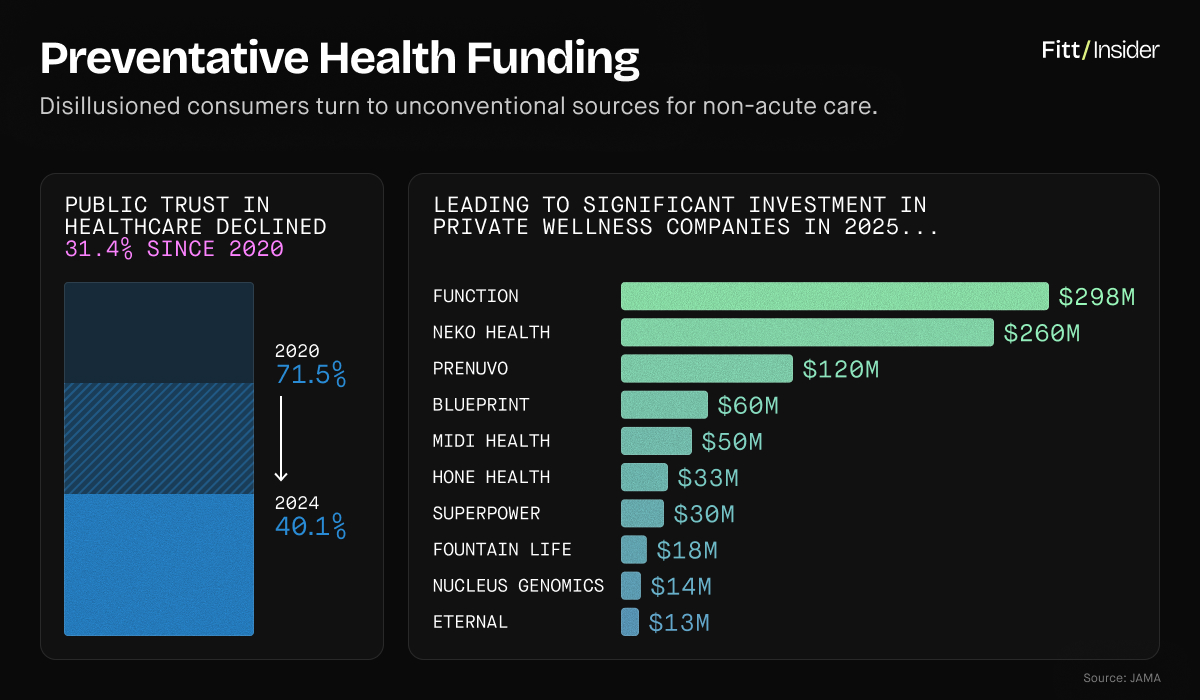
AI platforms are racing to translate scattered biometrics into clear direction, replacing data overwhelm with the holy grail, Personal Health OS. Of note, Function and Superpower secured fresh funds, with the former now worth $2.5B. Overall, the status quo is out of style, with everyone from OpenAI to Apple eyeing the Medicine 3.0 infrastructure opportunity.
As wearables chase healthcare integration, the FDA cracked down on wellness devices, issuing WHOOP a warning. Doubling down, WHOOP, Ultrahuman, and Oura all launched diagnostics. Pursuing a $100B vision, the latter won an ITC suit against competitors, deepened ties with the US DoD, debuted primary care partnerships, and closed a $900M+ Series E at an $11B valuation.
Critics say productizing care prices people out, but so do predatory insurance practices. Doctors worry the shift toward consumer-led solutions could foster a false sense of confidence that causes people to delay care — but facing labor shortages, the alternative is staying in the dark. An optimistic ideal, applying AI to the old guard could support high-quality systems for all.
Of the people
Consumers have spoken, and wellness evolved from aspiration to infrastructure. Projected to hit $10B by 2029, there’s almost no area of life wellness does not touch.
Influencing how people live, age, and connect, wellness culture is fundamentally reshaping American recreation, health systems, family choices, city plans, and even career paths.
Evolving from crash diets and no-pain, no-gain mantras to mindfulness and science-backed solutions, the category is anything but frivolous. In a world where uncertainty is the only promise, wellness instills survival skills.
Until Utopia exists, the pursuit of well-being will remain relevant and profitable.