For years, wellness sold products — a supplement, a tracker, a class, a serum. As the sector grew, consumers stopped buying “stuff” and started assembling stacks.
Now, people aren’t just stacking systems but designing their lives through the lens of wellness.
Wellness has graduated from a category to the orchestration layer linking fitness, healthcare, beauty, hospitality, retail, and tech, with companies in the space serving as cultural conductors.
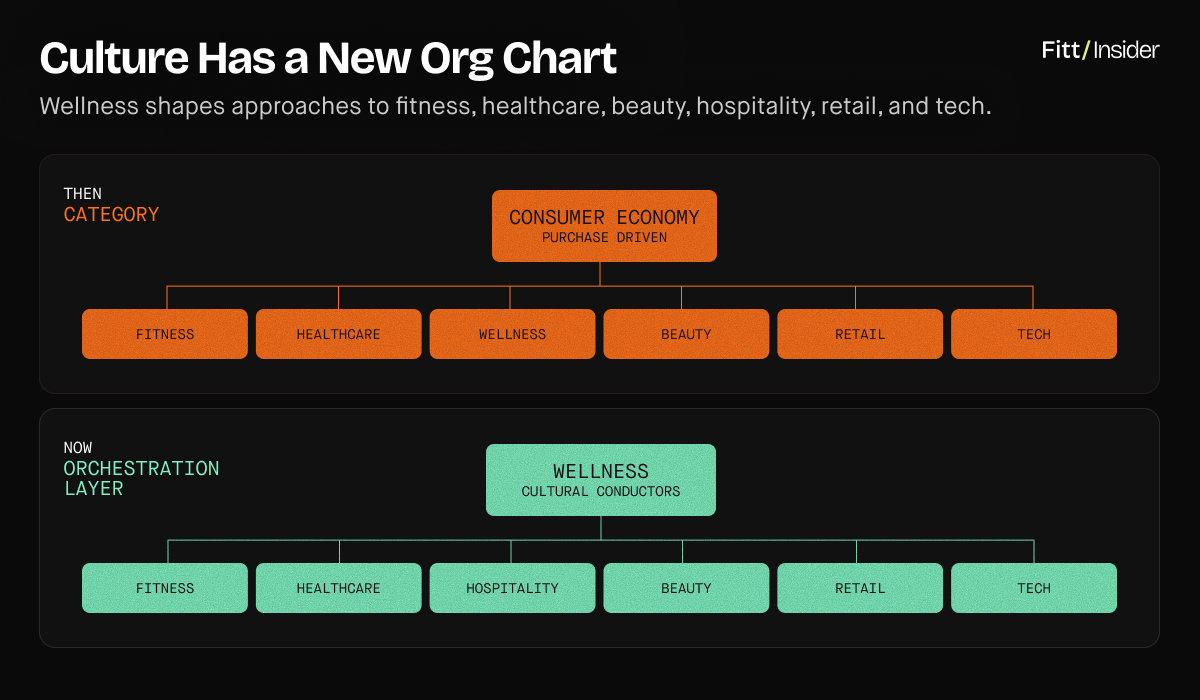
From Big Tech to heritage luxury, brands have recognized wellness now sits atop the cultural org chart. Everyone wants in on the boom, reactively building for every thinkable need.
But, no longer just playing to win customers, innovative companies are claiming and shaping subcultures, shifting wellness from transactional to experiential, communal, and ambient.
Our 2026 Halftime Report ties standout headlines to this macro shift. From fitness to pharma and beauty, recent developments reflect continued progress toward a Fluid Well-Being Loop.
Self Health
Massive raises and strategic acquisitions add up to an alternative health system.
As traditional healthcare gets more expensive and less effective, Americans aren’t waiting for systemic change; they’re seeking ways out. Medical tourism spiked, and DTC platforms strategically stoked discontent, rolling out major rogue marketing campaigns to capitalize. Wearables secured clinical partnerships, working toward frictionless EHR integration in an ongoing bid to become the new front door to care.
Big deals, WHOOP raised $575M at a $10B valuation, Oura crossed 5M members and filed for an IPO, and Google shook up the race with a subscription-free screenless Fitbit. Expanding their ecosystems, Hims & Hers bought Eucalyptus for >$1B, Midi Health raised $100M at a $1B valuation and launched skincare, and Function acquired SuppCo for supplement tracking alongside Getlabs for at-home bloodwork.
Advancing AI healthcare agents, Doctronic is piloting autonomous prescription renewals in Utah, while UpDoc’s Software as a Medical Device (SaMD) received FDA clearance and backing from major health and pharma orgs to automate between-visit care. Not to be outdone, OpenAI unveiled ChatGPT Health, Microsoft launched Copilot Health, and Midjourney announced advanced imaging wellness spas, positioning to win a growing population of “Self-Navigators.”
With floodgates open, Amazon’s One Medical launched GLP-1s and partnered with Lifeforce for longevity insights, while Costco stood up a fertility program, nesting accessible care within everyday retail. Rounding out the DIY healthcare system, Neko Health is bringing its full-body scans to NYC and Lotus raised $41M for free (sponsorship-enabled) AI-driven primary care.
Pushing toward at-home monitoring and interventions, the government invested in “noninvasive, closed-loop systems” for sleep, and early-mover Eight Sleep reached a $1.5B valuation while expanding predictive AI capabilities.
Helping consumers navigate the changing landscape, Garner raised $100M to transparently rank doctors, while care “advocate” companies like Solace and Baba birthed a new specialty. Thinking past wearables, Google research suggested diagnostic-equipped smartphones could democratize home health checks.
Key Insight: Platforms are expanding vertically and horizontally to remove friction and own the full care sequence — from front door (wearables, chatbots, and at-home tests) to interpretation (longitudinal tracking x AI translation) to insurance navigation, prescriptions, and supplements.
Exercise Era
Fitness becomes an anchor of both culture and care.
Now more identity than habit, young consumers consider fitness a status symbol. Gym membership hit record highs, with Gen Z accounting for 46% of signups, and wellness has spawned fresh social infrastructure — with run clubs replacing bars, marathons seeing record demand, and HYROX taking competitive fitness to new heights.
Leveraging social, recovery, and even coworking spaces for retention, gyms are becoming places people actually enjoy frequenting, making them ideal venues for embedded health services. Folding GLP-1 guidance, VO2 max, DEXA, bloodwork, and muscle-health measurement into memberships, brands like Monarch, Equinox, and Life Time are piloting gym-as-clinic models.
Consumers seeking healthy lifestyle hubs say gyms are the most important part of their wellness stack, with human connection and communal accountability amplifying outcomes.
But, as luxury high-performance branding becomes the norm, the average exerciser is losing affordable, nonintimidating starting options. After trading its “Judgement Free” messaging for optimization, Planet Fitness saw dropoff from casual exercisers and softened its outlook.
Noteworthy swings, Spotify launched a fitness vertical while Nike shuttered its owned studios, retooling around a partnership model with The Yard Gym. Wrapping AI around the industry, EGYM and Mindbody parent company Playlist merged in a $7.5B deal.
Key Insight: Fitness is no longer a vertical; it’s status, identity, and the starting point for a Personal Health OS. Declining for decades, nearly half of adults <30 don’t have a PCP, but gyms have become their favorite third place. Preventative care should meet them where they are. Bringing physicians in-house, gyms could solve adherence while bridging lifestyle and conventional medicine, becoming both clinical and cultural epicenters.
Wellness Pharm
Wellness evolves from hippie speak to deep science.
“Natural” products have given way to programmable biology, fueling peptides’ rapid evolution from gray-market substance to fundable consumer category. Noom bought a 503A compounding pharmacy, while startups Protocole, Feel Peptides, Noho Labs, Superpower, and System Labs launched physician-guided platforms.
The gateway drug, GLP-1s are now showing promise for use cases ranging from addiction to sleep apnea, with Hims, Novo, and Eli Lilly all betting on a pharma-led wellness future.
Creating a scientific halo around consumer longevity, deep health biotech breakthroughs made headlines, with Isomorphic Labs landing $2.1B for AI drug discovery, NewLimit raising $435M to restore cells, Sam Altman-backed Retro Biosciences reaching a $1.8B valuation, and David Sinclair’s Life Biosciences running the first reverse-aging drug trials in humans.
Key Insight: Deep biotech and consumer longevity aren’t the same but increasingly overlap. Products like peptides benefit from the growing perception that people have more control over biological fate than previously believed. An open variable, FDA regulation is an area to watch.
Biological Beauty
Loose language blurs lines between longevity and aesthetics.
Longevity has moved from a category to a claim, with beauty brands borrowing verbiage from biotech. From red light to topical peptides, beauty has repositioned as a scientific sector.
Prioritizing protocols over pampering, consumers are building routines spanning injectables, diagnostics, supplements, and wraparound clinical support while treating hormones, stress, sleep, and nutrition as beauty levers. Controversially, medspas have become de facto doctor’s offices, prescribing GLP-1s plus aesthetic procedures to match.
Pushing beyond vanity, next-gen personal care companies are making preventative health a value prop. New niches like AI-powered scalp, oral, and skincare systems have formed, and Thea debuted an aesthetics robo-doc. Damaging progress in the space, short-termism fueled looksmaxxing-focused concepts, arguably worsening the state of men’s wellness.
Keeping pace with industry-wide shifts, Ulta deepened its wellness focus and Estée Lauder invested in the convergence of beauty x longevity by backing 111SKIN. Connecting services, Fresha hit a $1B valuation for its self-care booking management platform spanning hair, aesthetics, spa, and fitness.
Key Insight: Beauty is being absorbed into the health OS, promising hotness, health, and happiness. The holy grail is a cross-sector platform that helps consumers honestly trace links between inner (nutrition, hormones, muscle, breath) and outer (skin, hair, facial structure) well-being — without upselling.
Forward Progress
Toward full-stack fellowship.
Last year, we defined Wellness 2.0. In the first half of this year, we’ve witnessed the start of a course correction. Anti-optimization made headlines and new archetypes—like Wellness Connoisseurs—emerged, demonstrating how diverse the sector has become.
It’s not just about health anymore. People are seeking products and services that reflect their values, using wellness as a lifestyle compass.
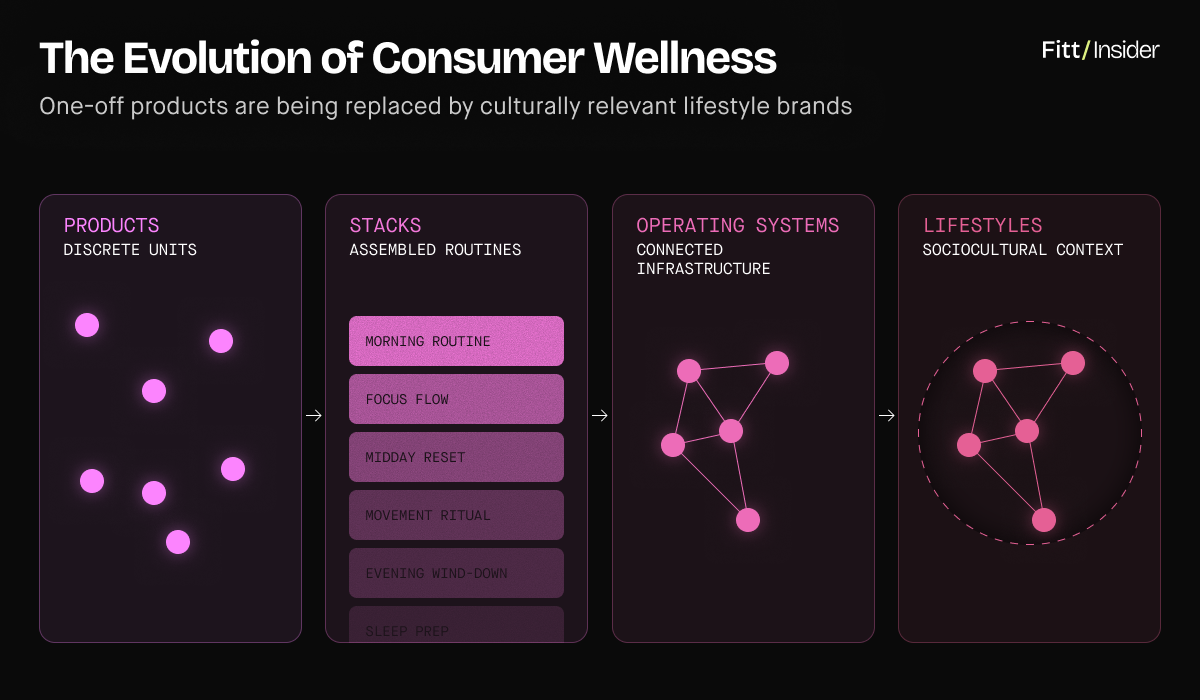
Some just want to be hot, some want strength to serve others, some still want to optimize, some want to party, and some lean intellectual. But the one thing they have in common is a desire to live life on their terms, with kindred spirits.
For brands, the barrier to entry is lower than ever, but so is trust. Thanks to AI, hyperskepticism is the default, making community and curation the most meaningful differentiators. Whether a gym, medspa, or AI coach, the 1,000 True Fans thesis is truer today than in 2008.
In the modern wellness landscape, the endpoint isn’t a customer but a citizen of an OS with particular principles. After establishing a clear ethos and competency in one specialty, brands are leveraging earned capital and clout to cross categories, seducing people to spend more of their lives inside singular ecosystems while creating moats through longitudinal data collection.
Guiding people through their Hero’s Journey is the game, and worldbuilding is the playbook.